Even in an emergency, when clinical conditions allow, surgery can be performed through small incisions.
Emergency surgery requires
- Rapid decisions
- Experience
- The ability to adapt the operative strategy to the patient's condition
Today many acute abdominal conditions can be treated with laparoscopic and robotic techniques, avoiding the large incisions of traditional surgery.
When can laparoscopy be used in an emergency?
A surgical emergency is not, in itself, a contraindication to laparoscopy.
The minimally invasive approach can be used for:
The choice depends mainly on:
Patient stabilityhaemodynamic and respiratory conditions compatible with surgery.
Type of conditionsite, severity and extent of the disease process.
Abdominal conditionsbowel dilatation, adhesions, inflammation and peritoneal contamination.
Team experienceavailability of skills and instruments suited to the procedure.
Good to know
In the presence of severe instability, or when laparoscopy does not allow safe treatment, open surgery may be necessary.
Which emergency operations can be performed laparoscopically?
Select a condition
Acute appendicitis
Laparoscopic appendicectomy removes the inflamed appendix through small abdominal incisions.
It is one of the minimally invasive procedures most frequently performed in emergencies and can also be used in many cases of complicated appendicitis.
Acute cholecystitis
Cholecystitis is an acute inflammation of the gallbladder, often associated with gallstones.
Laparoscopic cholecystectomy allows the gallbladder to be removed even during the inflammatory phase, when clinical and anatomical conditions allow.
Bowel obstruction
Bowel obstruction can be caused by
- adhesions
- hernias
- strictures
- other conditions
Laparoscopy makes it possible to identify the cause of the obstruction and treat it by releasing adhesions, reducing a hernia or resecting the compromised section of bowel when necessary.
Incarcerated or strangulated hernias
Inguinal, femoral and umbilical hernias and incisional hernias can become complicated by entrapment of the hernia contents and, in the most severe cases, by interruption of their blood supply.
Laparoscopy makes it possible to reduce the hernia, assess the viability of the bowel and repair the defect.
The reconstructive technique and any use of mesh depend on the condition of the tissues and the degree of contamination.
Gastrointestinal perforations
Some perforations of the stomach, duodenum or bowel can be treated with laparoscopic surgery.
The operation may include
- identification of the perforation
- suture of the lesion or resection of the affected section
- washout of the abdominal cavity
The choice depends on the site of the perforation, the severity of the peritonitis and the patient's general condition.
Complicated acute diverticulitis
When diverticular disease is complicated by
- perforation
- peritonitis
- obstruction
urgent surgery may be needed.
In selected patients, a laparoscopic resection of the affected section of bowel can be performed, with restoration of intestinal continuity or creation of a stoma if needed.
Robotic surgery in emergencies too?
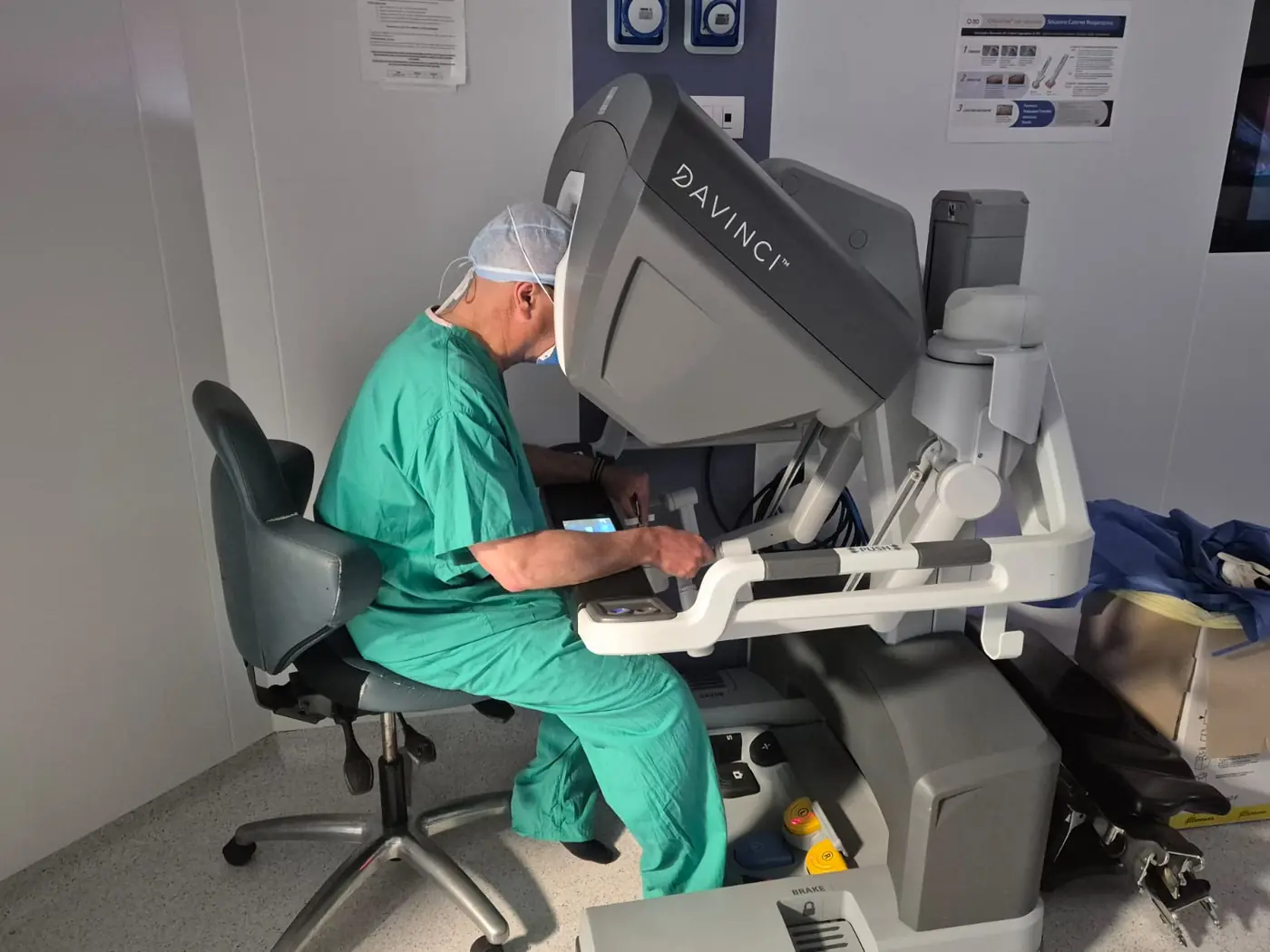
Robotic surgery can be a further option in some urgent operations, thanks to three-dimensional vision and the precision of articulated instruments.
Its use, however, depends on
- Immediate availability of the platform
- Team experience
- Complexity of the case
Robotics must not delay urgent treatment or replace a faster and safer laparoscopic or open approach.
The advantages of minimally invasive emergency surgery
When clinically appropriate, laparoscopy can offer several advantages over open surgery:
Small incisionsless trauma to the abdominal wall.
Less postoperative paingenerally reduced compared with large incisions.
Exploration of the abdominal cavitythe cause of the emergency can be identified and treated.
Early mobilisationfaster return to movement.
Potentially shorter hospital stayeven in more complex cases.
Faster recoverygradual return to normal activities.
Recovery after minimally invasive emergency surgery
- Early mobilisation
- Better pain control
- Faster return to daily activities
- Short hospital stay, depending on the condition
Emergency surgery: experience and minimally invasive techniques
Choosing the most appropriate surgical approach requires a timely assessment of the clinical condition and the disease.
Dr Gabriele Manetti practises general and minimally invasive surgery, with particular focus on laparoscopic and robotic techniques.
Frequently asked questions
Can a laparoscopic operation be performed in an emergency?
Yes. Many acute abdominal conditions, such as appendicitis, cholecystitis, bowel obstruction and complicated hernias, can be treated with laparoscopic techniques in selected patients.
Is laparoscopy safe in the presence of peritonitis?
In some cases, yes. Whether laparoscopy can be used depends on the cause of the peritonitis, its extent and the patient's condition. In the most severe situations open surgery may be needed.
Can a strangulated hernia be operated on laparoscopically?
Yes, in selected cases. Laparoscopy makes it possible to assess the hernia contents and the viability of the bowel, and to repair the defect when conditions allow.
Can the robot be used in emergency operations?
Yes, in selected situations and when a robotic platform and an experienced team are available. The choice must always guarantee timely and safe treatment.
How long does recovery take after an emergency laparoscopic operation?
It depends on the condition and the severity of the clinical picture. After uncomplicated operations recovery can be rapid, while major infections, peritonitis and bowel resections may require longer hospital stays and recovery times.