On this page
An incisional hernia is a hernia that develops at the site of a previous abdominal surgical scar.
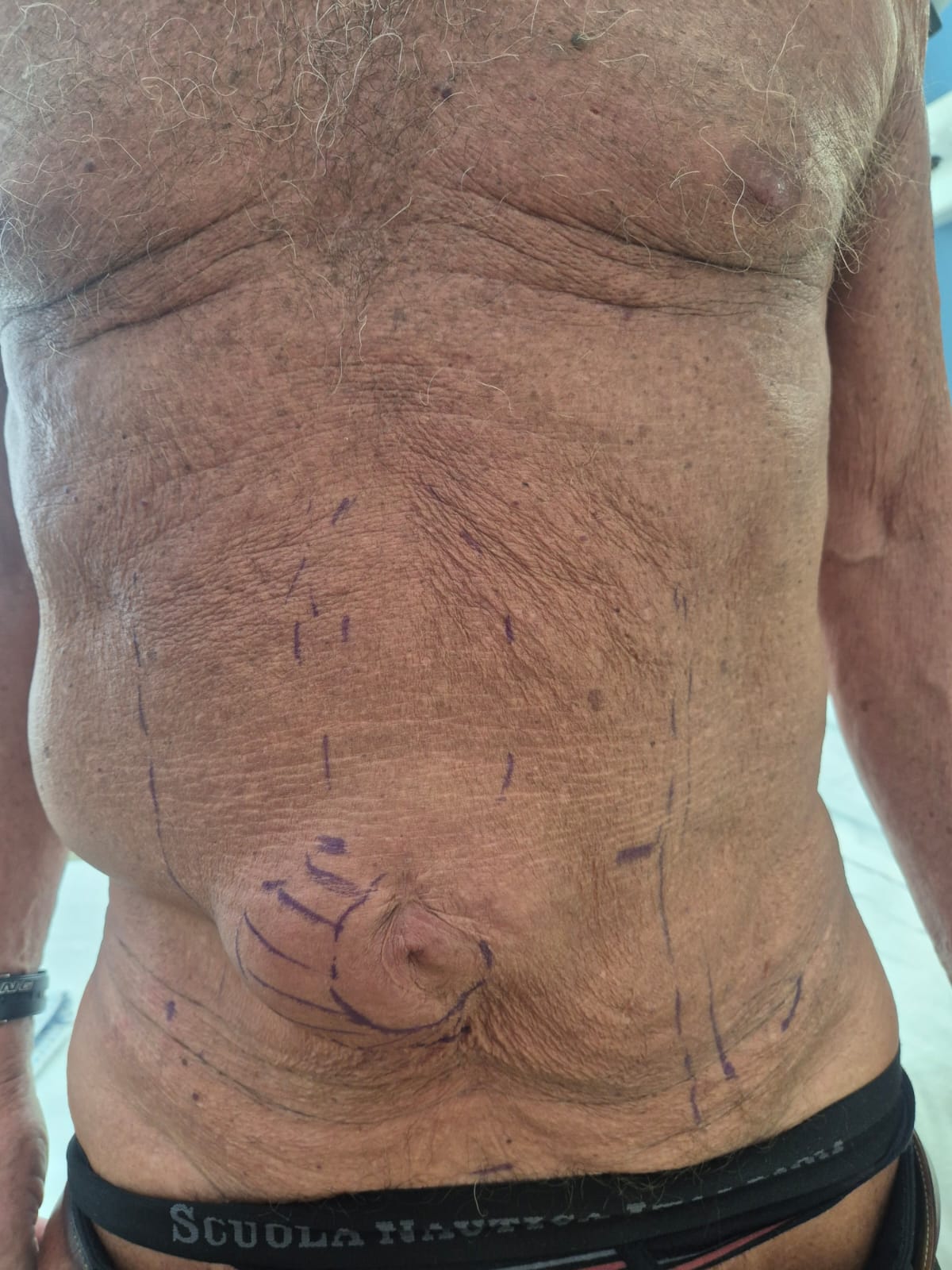
It can occur after conventional or laparoscopic surgery (less commonly).
Treatment requires a thorough specialist assessment: it is not simply a matter of closing a defect, but of reconstructing the abdominal wall so that it is stable, functional and durable over time.
What is an incisional hernia?
A hernia at a surgical scar, also called an incisional hernia, is a failure of the abdominal wall at the site of a previous surgical incision.
After surgery, the deep scar can represent a point of reduced strength. When the muscle and fascial layers give way, the abdominal contents can push outwards and create a visible or palpable swelling.
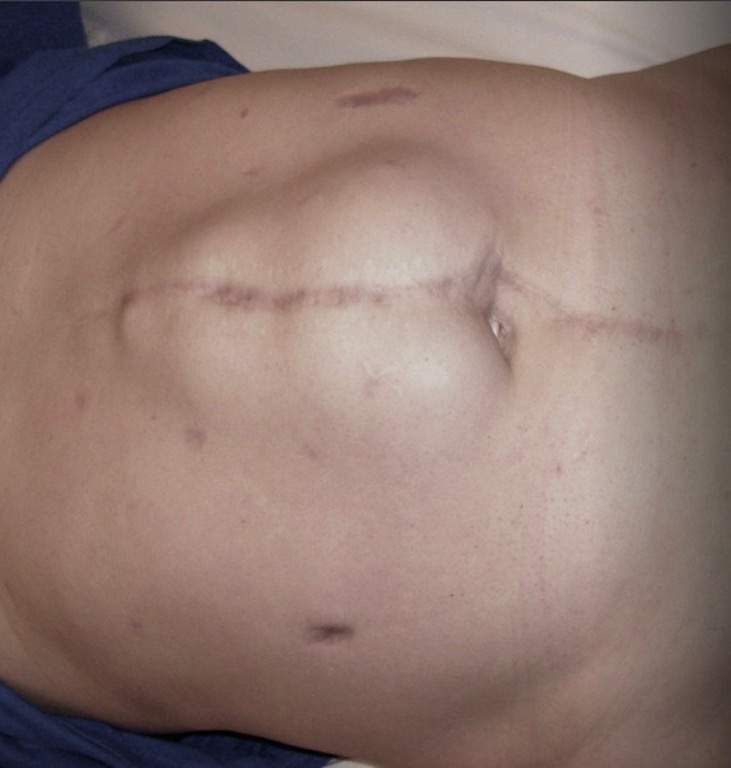
Small and localised
Extend along a larger scar
In some cases it is associated with diastasis recti, widespread abdominal wall weakness or previous repairs.
Symptoms of an incisional hernia
The most common symptom is the appearance of a bulge at the surgical scar site, more noticeable:
Other possible symptoms include:
- a feeling of heaviness or abdominal tension;
- pain during movement, coughing or physical activity;
- difficulty contracting the abdominal muscles properly;
- a feeling of abdominal wall instability;
- progressive increase in the size of the swelling;
- limitations in daily activities or sport;
- disturbances in the passage of stool and wind.
In some patients, an incisional hernia may cause little pain but slowly increase in size over time.
Why a hernia develops at a scar site
An incisional hernia develops when the deep surgical scar does not retain its strength over time. Factors that may contribute include:
The problem involves not only the skin or the visible scar, but the deep layers of the abdominal wall.
Diagnosis of an incisional hernia
Specialist surgical consultation
The consultation assesses:
- site and size of the defect;
- relationship to the previous scar;
- reducibility of the incisional hernia;
- presence of other abdominal wall defects;
- any associated diastasis recti;
- the patient's symptoms and functional limitations.
Abdominal wall ultrasound
An abdominal wall ultrasound is also performed during the consultation to rapidly assess:
CT or MRI with the Valsalva manoeuvre
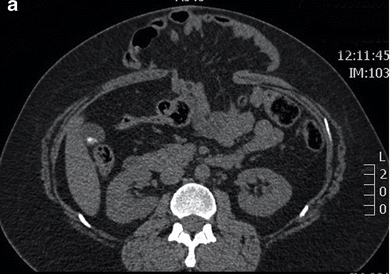
These are needed to assess the characteristics of the defect properly and plan the most appropriate operation. Second-line imaging allows us to assess precisely:
- Size at rest and on straining
- Hernia contents
- Muscle bulk and condition
- Presence of obstructive mechanisms
- Volume of the abdominal cavity and hernia sac
- Other associated defects
Incisional hernia and diastasis recti
With an incisional hernia, the entire abdominal wall must be assessed. The presence of diastasis, multiple defects or midline weakness can radically alter the surgical strategy.
When indicated, treatment may involve reconstruction of the entire midline:
Complex or recurrent incisional hernia
Certain features can make an incisional hernia more complex to treat, including:
- large defects, for example greater than 10 cm;
- recurrence after previous repair;
- multiple defects;
- presence of previously placed mesh;
- loss of domain;
- obesity;
- significant changes in the abdominal wall musculature;
- multiple previous operations.
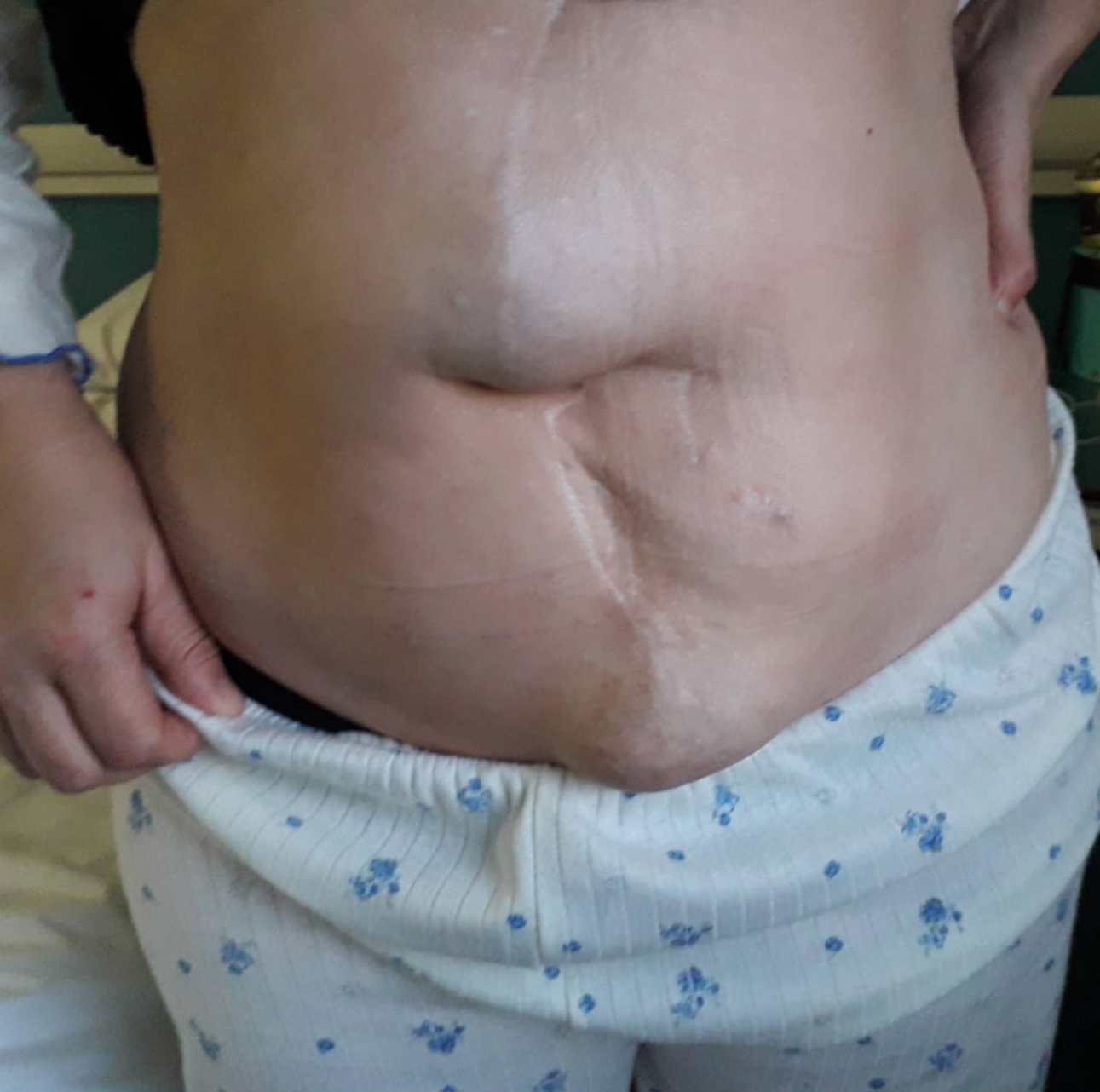
Complex incisional hernia surgery requires specific expertise in abdominal wall reconstruction.
When to operate on an incisional hernia
An incisional hernia does not close spontaneously. Surgery is indicated when it:
A planned assessment allows the incisional hernia to be treated under the best conditions, before any acute complications arise.
Incisional hernias are more complex than primary hernias
An incisional hernia can be more complex than a primary hernia, such as anumbilical hernia o epigastric hernia, because it develops in an abdominal wall that has already undergone surgery.
After previous surgery, there may be postoperative adhesions, which are fibrous bands between the bowel, omentum, peritoneum and abdominal wall. These adhesions can make the situation more delicate and increase the risk of complications, particularly when a portion of bowel enters the hernia defect.
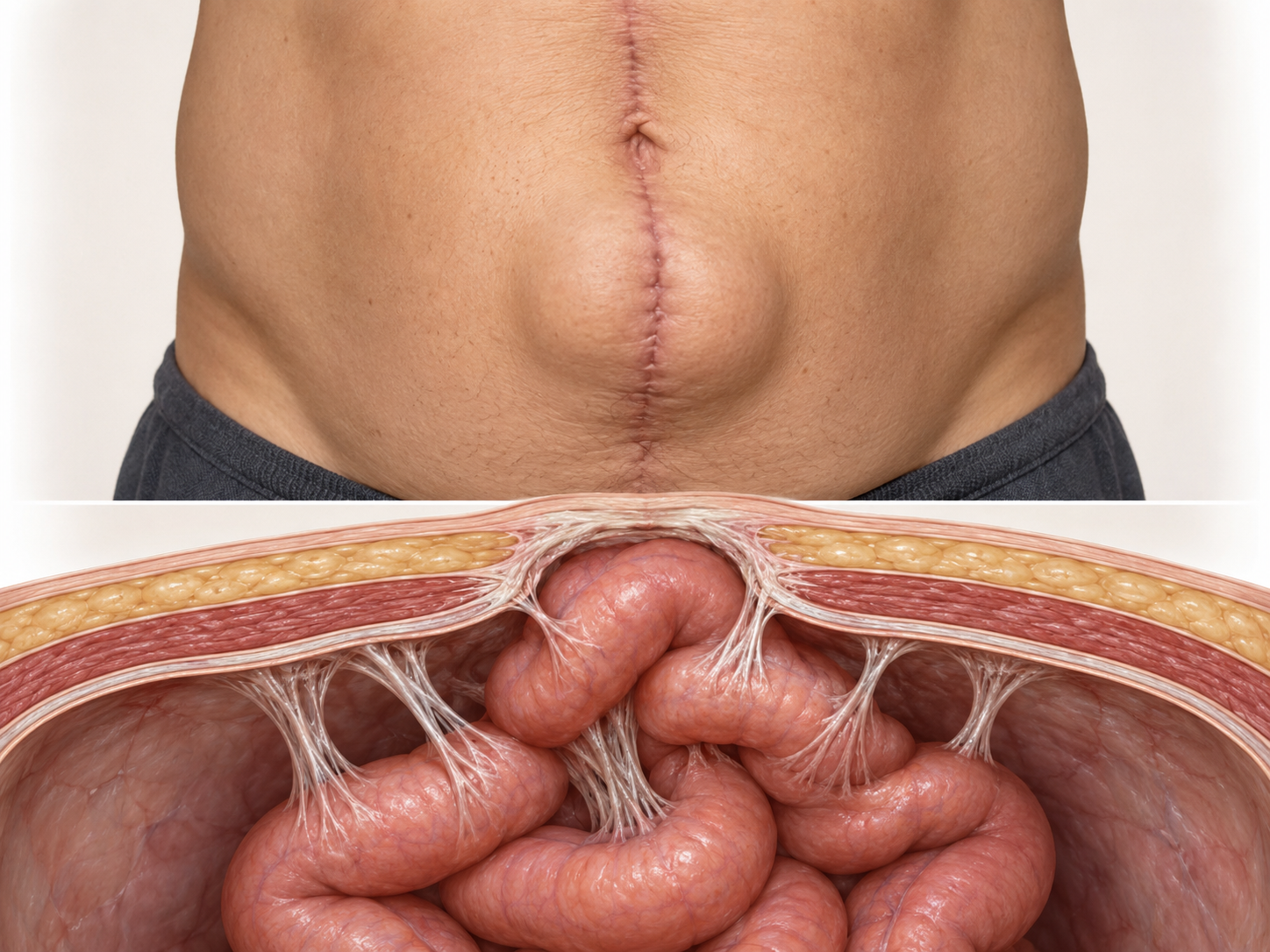
The most feared complications are:
Incarceration
when the hernia contents become trapped within the defect;
Strangulation
when the blood supply to the herniated contents is compromised, with a risk of intestinal ischaemia;
Bowel obstruction
when the passage of stool and wind stops.
Warning symptoms: urgent assessment
- sudden, severe pain at the incisional hernia site;
- a hard, tender swelling that cannot be reduced;
- nausea or vomiting;
- inability to pass stool or wind;
- a swollen or very painful abdomen;
- red, purple or warm skin over the swelling;
- rapid worsening of symptoms.
If these signs are present, urgent treatment may be needed, because the incisional hernia may have become complicated by incarceration, strangulation or bowel obstruction.
Early specialist assessment, by contrast, allows surgery to be planned under the best conditions, reducing the risk of an emergency and selecting the most suitable technique for each case.
Preparation before surgery
In incisional hernia surgery, the outcome also depends on patient preparation. When necessary, the pathway may include:
Incisional hernia surgery
Incisional hernia surgery aims to repair the defect and strengthen the abdominal wall by suturing the defect and reinforcing it with mesh.
The aim is to achieve a stable, lasting repair, reducing the risk of recurrence and improving abdominal wall function.
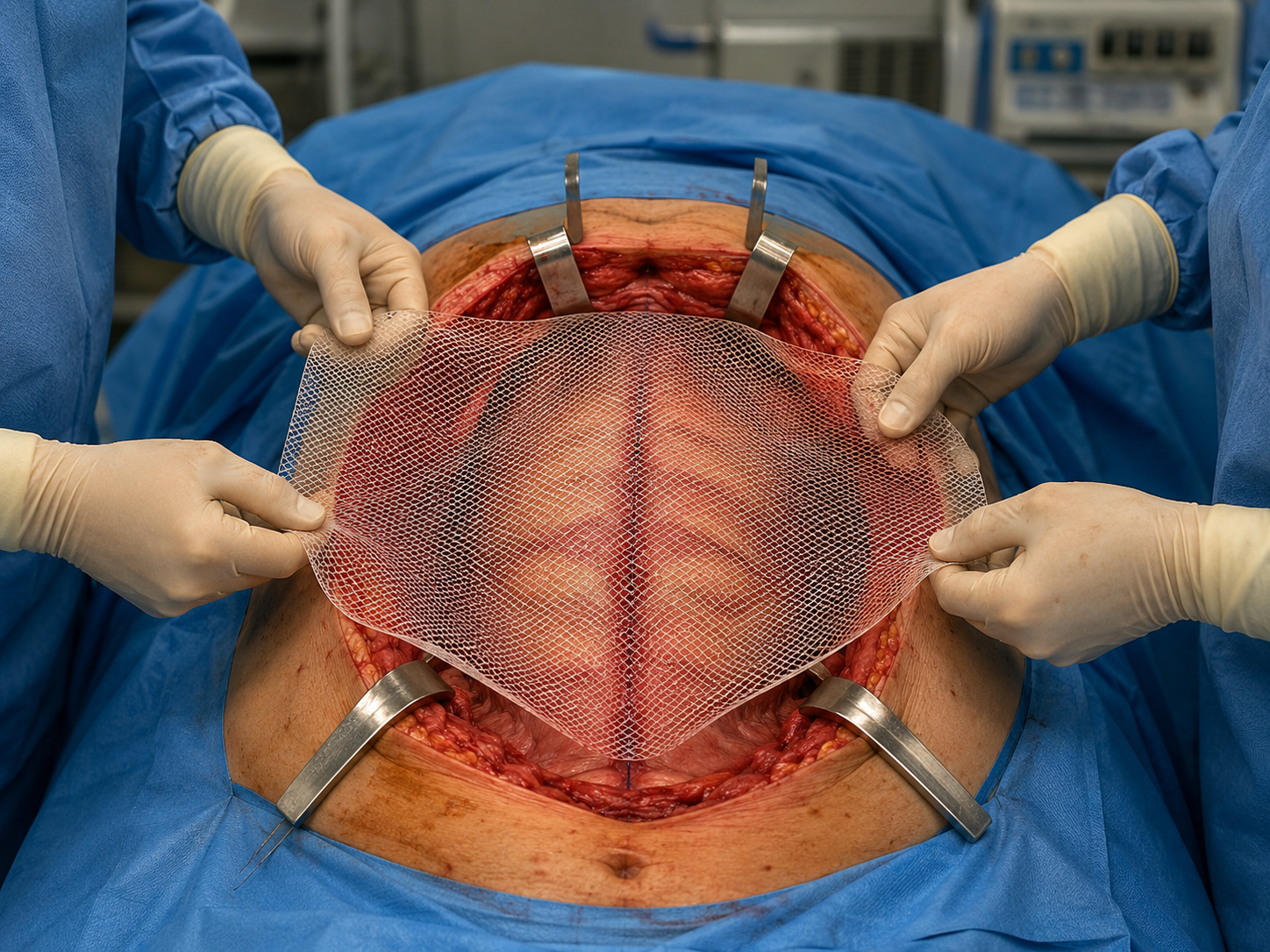
Open surgery
Reconstructing the wall, not simply covering the defect
Reconstruction of the fascial layers
Where possible, the aim is to bring together and reconstruct the fascial layers of the abdominal wall, preventing the mesh from simply acting as a bridge between the edges of the defect.
This will allow the formation of a strong, lasting scar.
Where is the mesh placed?
Mesh is always placed during incisional hernia repair surgery.
Where is the mesh placed?
When a prosthesis is used, it can be placed in different anatomical planes. The choice depends on the type of hernia and the surgical strategy.
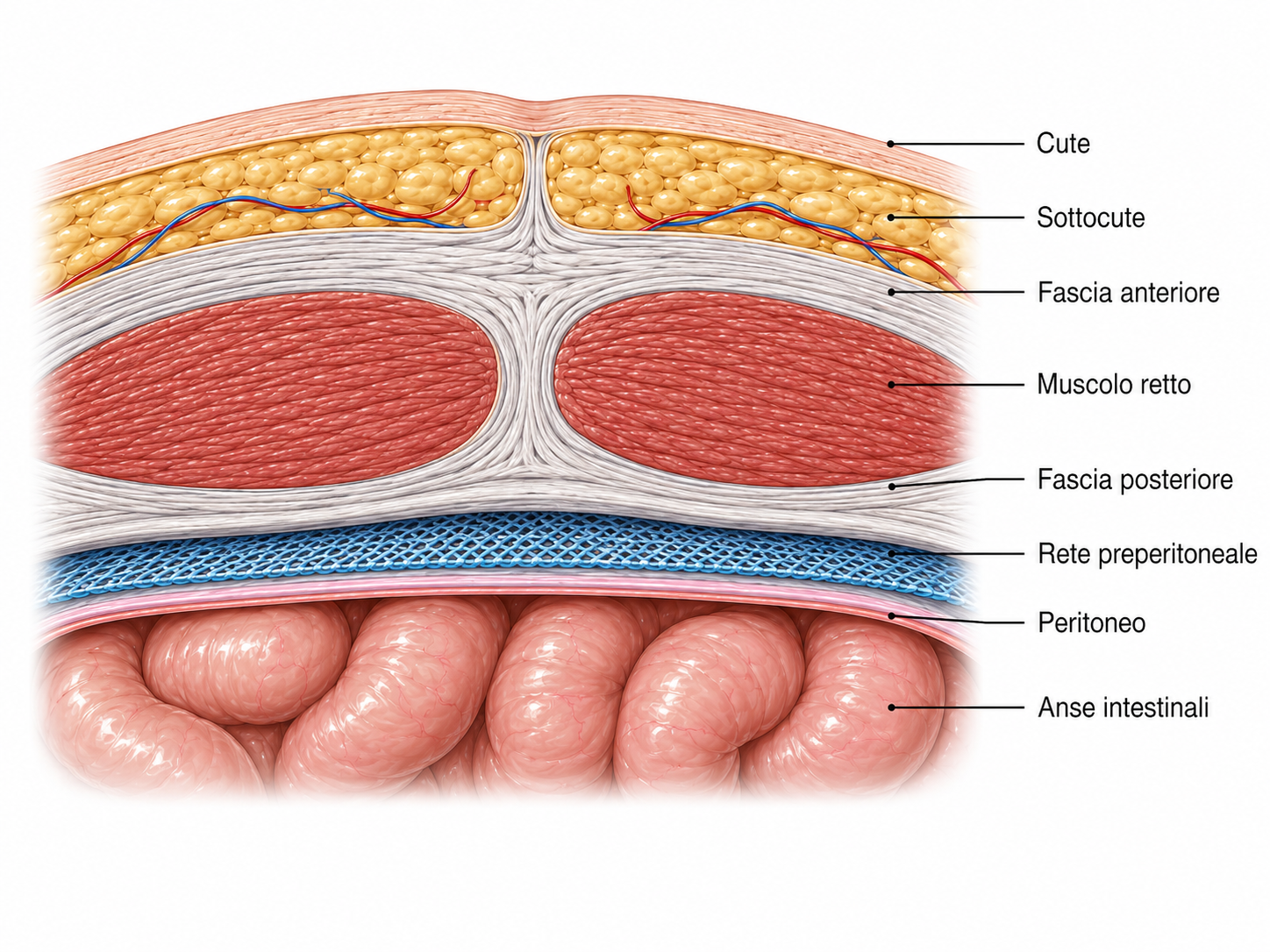
The mesh is positioned behind the fascial wall and in front of the peritoneum. Indicated for specific patient groups.
The choice of mesh placement plane is part of the reconstructive strategy and should not be considered independently of the type of defect and the type of patient.
The choice of mesh must ensure lasting reinforcement and be suitable for the patient, based on their daily activities and comorbidities.
Recovery after incisional hernia surgery
Recovery depends on the type of incisional hernia, the technique used and the patient's general condition.
After surgery, it is important to allow time for the abdominal wall to heal and avoid early exertion: the healing time for the muscle fascia is 90 days.
- Immediately
Immediate return to daily life
- After approximately 50 days
Start of abdominopelvic rehabilitation
- In combination
Passive and active electrical stimulation sessions
- From approximately 90 days
Gradual reintroduction of physical exercise
The postoperative pathway is also personalised according to the type of surgery performed and the complexity of the defect.
Specialist consultation for incisional hernia in Rome
The incisional hernia consultation is when the structure of the abdominal wall is assessed, the defect is measured and the most appropriate pathway is decided. No single technique suits everyone: the choice depends on the size of the hernia, tissue quality, the presence of diastasis or adhesions and the patient's general condition.
Comprehensive assessment
Clinical examination, abdominal wall ultrasound and, if necessary, CT with the Valsalva manoeuvre.
Tailored technique
Open, laparoscopic or robotic: the approach is chosen on a case-by-case basis.
Rehabilitation pathway
A personalised plan for a safe return to daily life and sport.
During the consultation, I will clearly explain the options, benefits and limitations of each approach, so that we can decide together on the strategy best suited to your needs.
Frequently asked questions about incisional hernias
Is an incisional hernia a type of hernia?
+
Yes. An incisional hernia is a hernia that develops at a previous abdominal surgical scar.
Can an incisional hernia heal on its own?
+
No. The abdominal wall defect does not close on its own; treatment is surgical.
Is mesh always needed?
+
Yes, the prosthesis is needed to reinforce the abdominal wall and reduce the risk of recurrence.
Can it be repaired using laparoscopic or robotic surgery?
+
Yes. Laparoscopic or robotic surgery can be used depending on the defect and patient characteristics.
When does an incisional hernia become urgent?
+
You should seek prompt medical attention if an incisional hernia suddenly becomes painful, hard, irreducible or associated with nausea, vomiting, fever or abdominal distension.
Can an incisional hernia increase in size over time?
+
Yes. In some patients, the defect may progressively enlarge and become more noticeable or symptomatic.
Can an incisional hernia and diastasis be repaired together?
+
When the two conditions coexist, the strategy involves comprehensive reconstruction of the midline and abdominal wall.