Robotic surgery is an evolution of minimally invasive surgery. The operation is performed through small incisions using a robotic platform controlled directly by the surgeon.
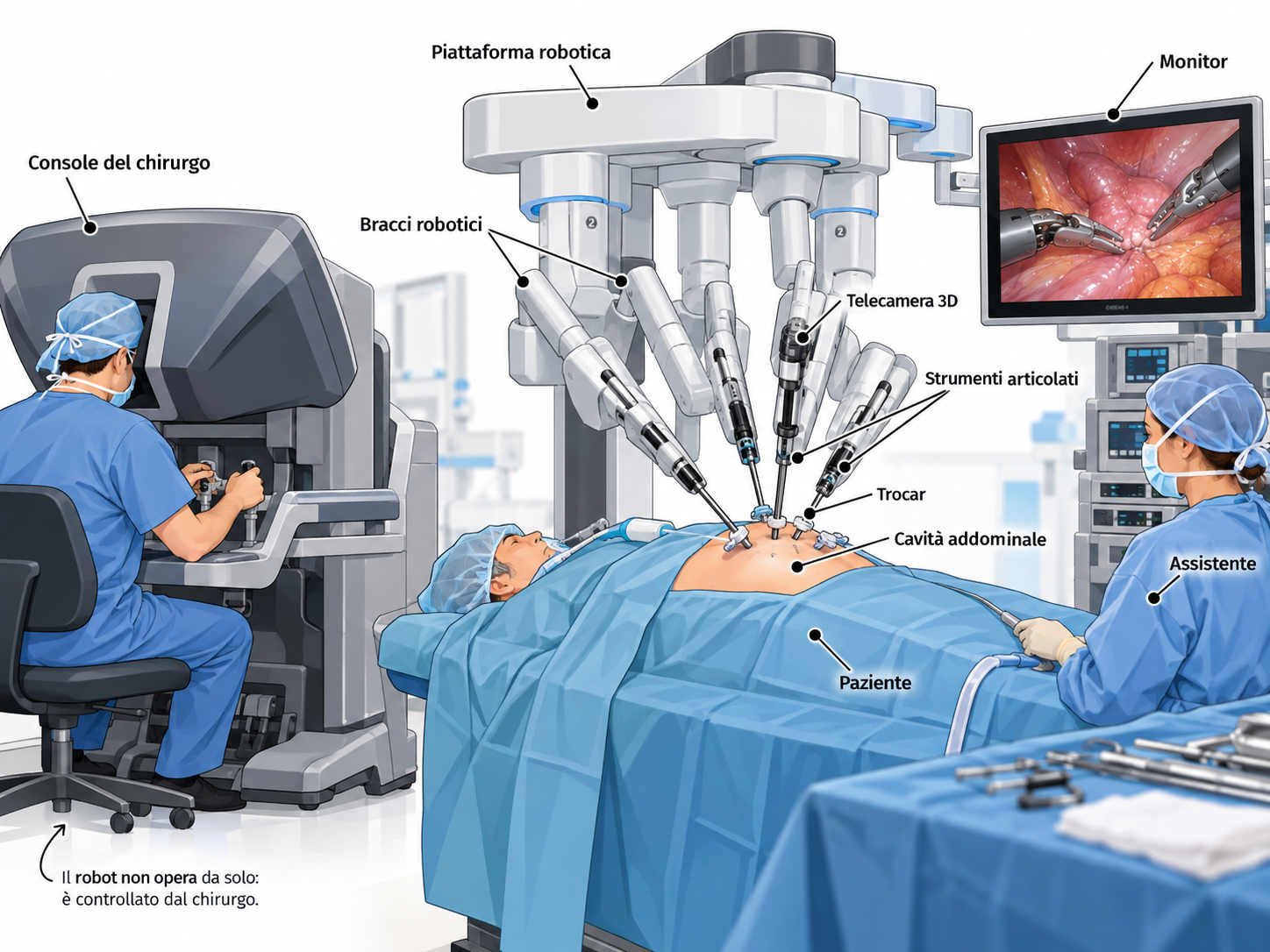
The robot does not perform the operation autonomously
Every instrument movement is commanded by the surgeon from the console.
The objective remains that of minimally invasive surgery: treating disease while reducing surgical trauma to the abdominal wall and tissues.
Robotic technology is a tool. The choice of approach depends first and foremost on the condition, anatomy and objectives of the operation.
How robotic surgery works
As in laparoscopy, the abdomen is accessed through trocars, cannulas introduced through small incisions.
The abdominal cavity is generally expanded using CO₂, creating the space required to visualise and treat the organs.
A camera provides a magnified, high-definition view of the operative field. In robotic surgery, the surgeon works from a console and controls articulated instruments connected to the platform's arms.
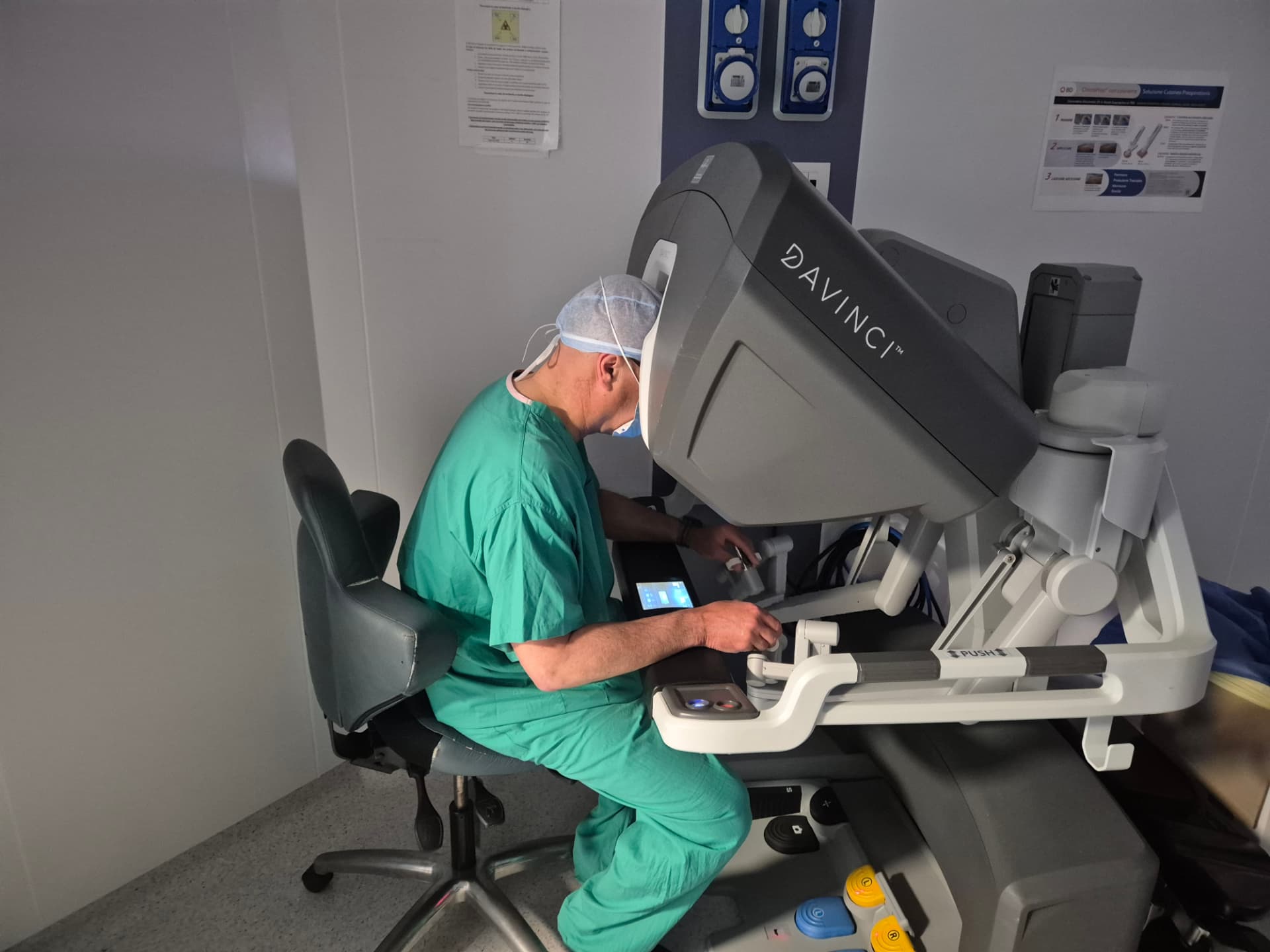
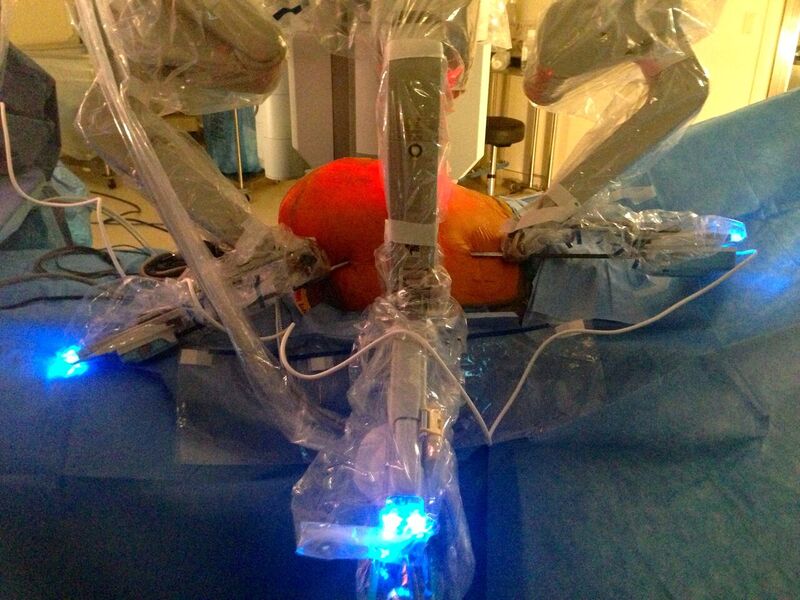
Three-dimensional vision
The system provides a magnified three-dimensional view of the operative field, particularly useful during fine anatomical dissection, suturing and reconstruction of different tissue layers.
Articulated instruments
Robotic instruments have joints that allow a very wide range of movement within the operative cavity.
Surgeon control
The surgeon's hand movements are transmitted to the robotic instruments in real time. The robot neither makes decisions nor operates autonomously.
Robotic surgery and laparoscopy: what is the difference?
Both are forms of minimally invasive surgery and use small access points rather than the large incisions of traditional surgery.
The surgeon directly manipulates rigid instruments introduced through the trocars.
The instruments are controlled through a console and offer three-dimensional vision, articulation, freedom of movement, easier intracorporeal suturing and ergonomics.
Robotic surgery is not necessarily better than laparoscopy for every operation.
Why robotic surgery is particularly useful in abdominal wall surgery
Less trauma to the abdominal wall
Performance of complex procedures
Three-dimensional, highly detailed vision
Ability to perform complex sutures
Benefits of the minimally invasive approach in abdominal wall surgery
Robotic surgery does not mean simple surgery
Some procedures performed through small access points are technically complex abdominal wall reconstructions.
Which abdominal wall conditions can be treated robotically?
In selected cases, recurrent incisional hernias, lateral hernias and complex abdominal wall defects may also be treated.
Robotic abdominal wall techniques
Robotic visceral surgery
Colorectal surgery
Robotic surgery may be used for colon and rectal resections for:
- Benign conditions
- Diverticular disease
- Neoplastic conditions
Three-dimensional vision and articulated instruments may be particularly useful in pelvic dissection and rectal surgery.
Pelvic floor surgery
Minimally invasive treatment of pelvic organ prolapse and selected posterior compartment disorders may benefit from precise robotic dissection and suturing. In appropriately selected patients, procedures include:
- POPS
- Sacrocolpopexy
- Ventral rectopexy
- Dubuisson
Gallbladder surgery
In selected cases, the robotic platform may also be used in gallbladder surgery.
Anaesthesia in robotic surgery
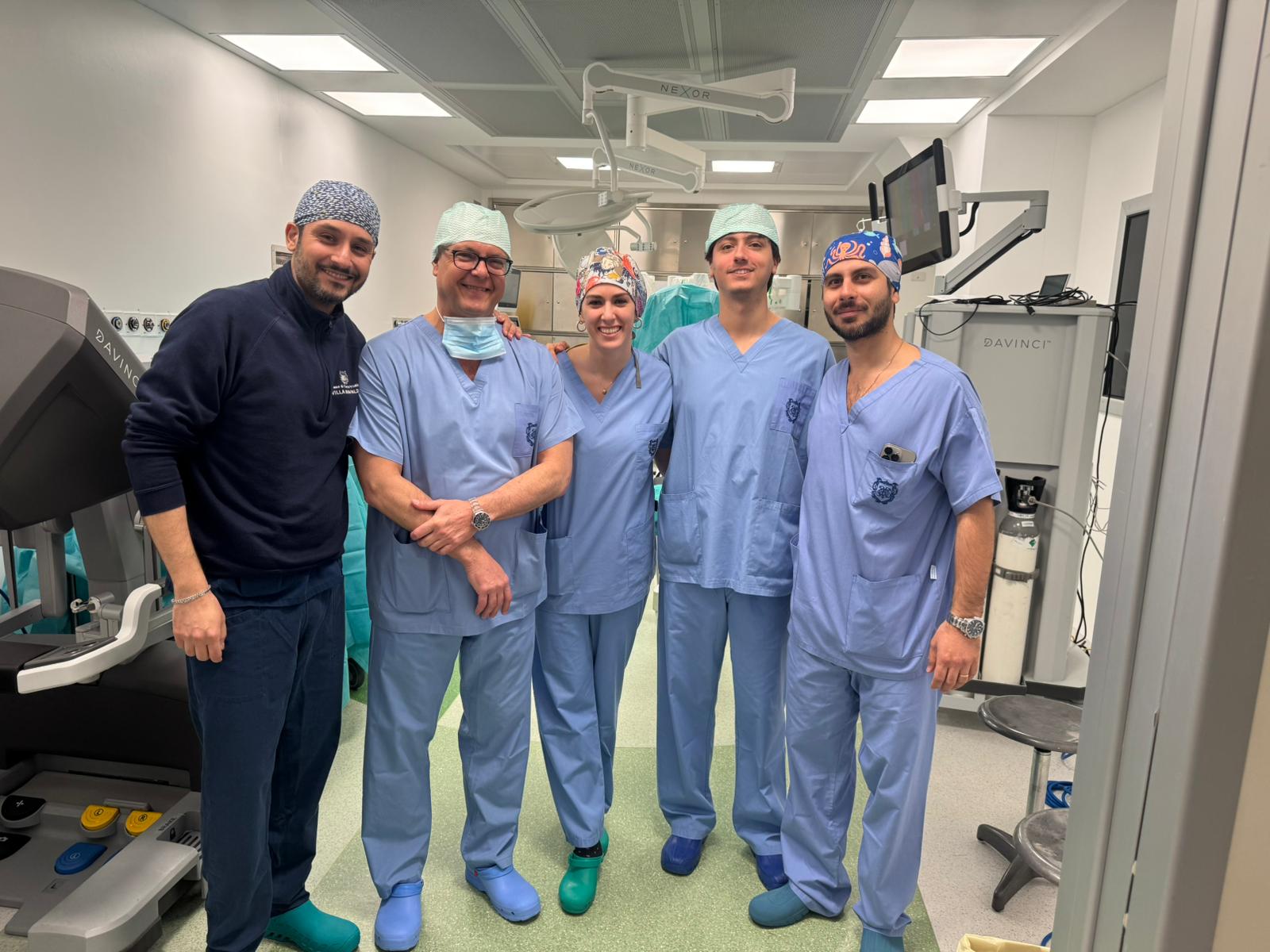
The dedicated team allows us to perform robotic procedures without intubation, using general anaesthesia combined with analgesic blocks.
Length of hospital stay
The length of stay depends much more on the procedure performed than on whether or not a robot is used.
Day surgery
Possible in selected patients undergoing robotic inguinal and femoral hernia repair.
Short stay (one night)
Most abdominal wall procedures involve one night in hospital.
Standard admission (more than one night)
This may be required for more complex procedures, major abdominal wall reconstructions, cancer surgery or when clinical conditions require longer monitoring.
Frequently asked questions about robotic surgery
Does the robot operate autonomously?
No. The robot is a platform controlled entirely by the surgeon. Every instrument movement derives from commands given at the console.
Are robotic and laparoscopic surgery the same?
Both are minimally invasive techniques, but they use different instruments. In laparoscopy, the surgeon moves the instruments directly; in robotic surgery, the surgeon controls them through a console.
Is robotic surgery always better than laparoscopy?
No. The choice depends on the procedure and the patient. Laparoscopy is entirely appropriate for many operations; robotic surgery may offer technical advantages particularly in procedures requiring complex dissection and reconstruction.
Can hernias be operated on robotically?
Yes. Inguinal and ventral hernias, incisional hernias, rectus diastasis associated with hernias and selected complex defects can be treated through a robotic approach in appropriately selected patients.
Does robotic surgery leave smaller scars?
Operations are generally performed through small trocar access points. The number and position of the incisions depend on the procedure.
Is mesh still used for hernias with robotic surgery?
Yes, mesh may also be used in robotic hernia surgery.