On this page
An crural hernia, also called femoral hernia, is a wall defect located in the inguinofemoral region, lower down than a typical inguinal hernia.
The abdominal contents pass through the femoral canal, a narrow anatomical area immediately below the inguinal ligament and close to the femoral vessels.
Pain below the groin during sport?
In female athletes, deep pain in the groin crease or upper inner thigh can easily be attributed to the adductors, pubalgia or the hip. However, a small femoral hernia may be barely visible and present mainly during running, squats, weightlifting or exercises that increase abdominal pressure.
What is a crural or femoral hernia?
The femoral canal is a small anatomical space located in the lower part of the groin region.
When fatty tissue, peritoneum or other abdominal contents enter this space, a femoral hernia forms.
Where does it appear?
Typically:
This different location is one of the key features used to distinguish femoral hernias from inguinal hernias.
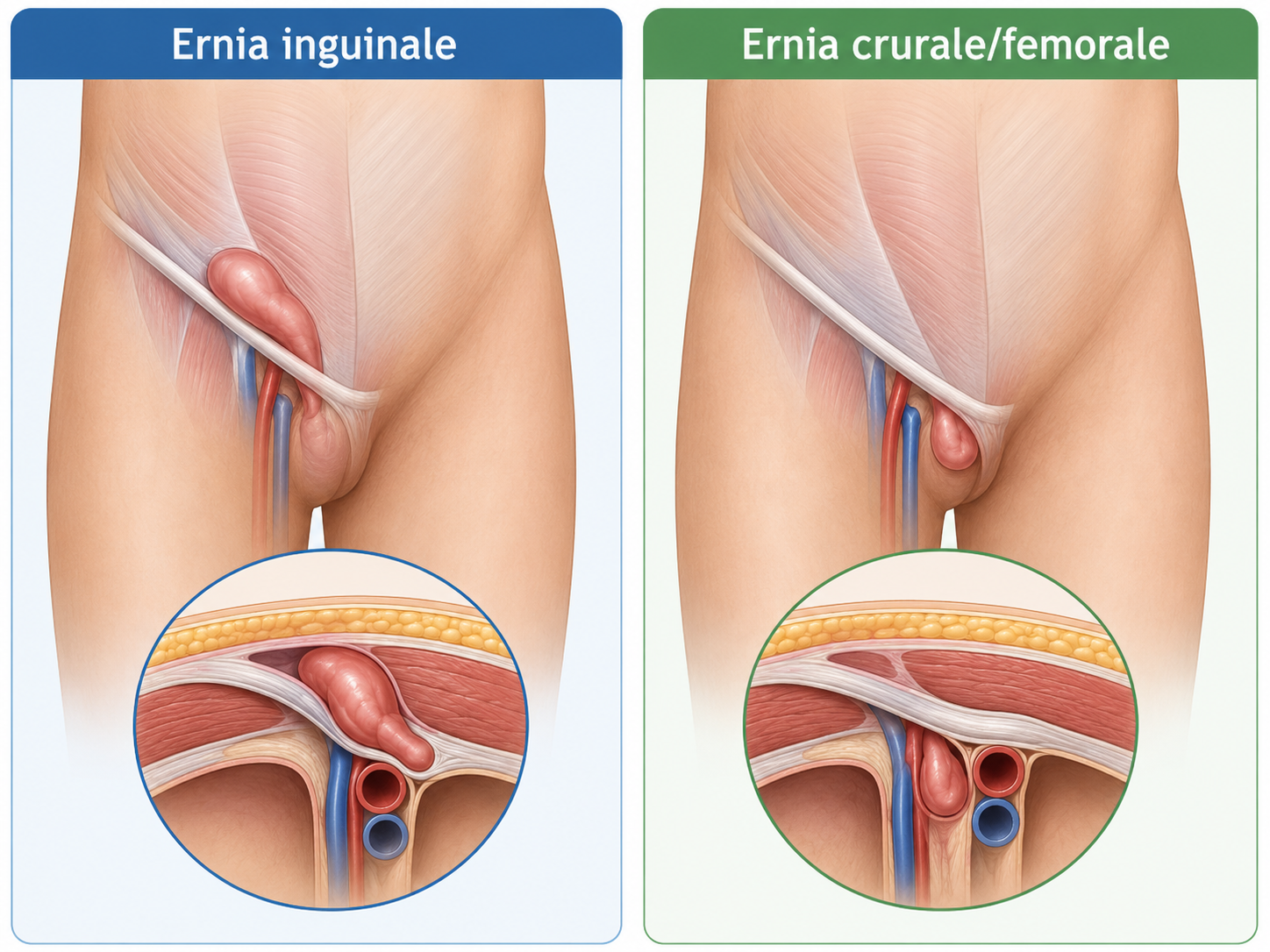
What can it contain?
The contents may include:
- preperitoneal fat;
- omentum;
- peritoneum;
- in some cases, a loop of bowel.
The external swelling may be small even when the contents are firmly lodged in the canal.
Femoral and inguinal hernias: what is the difference?
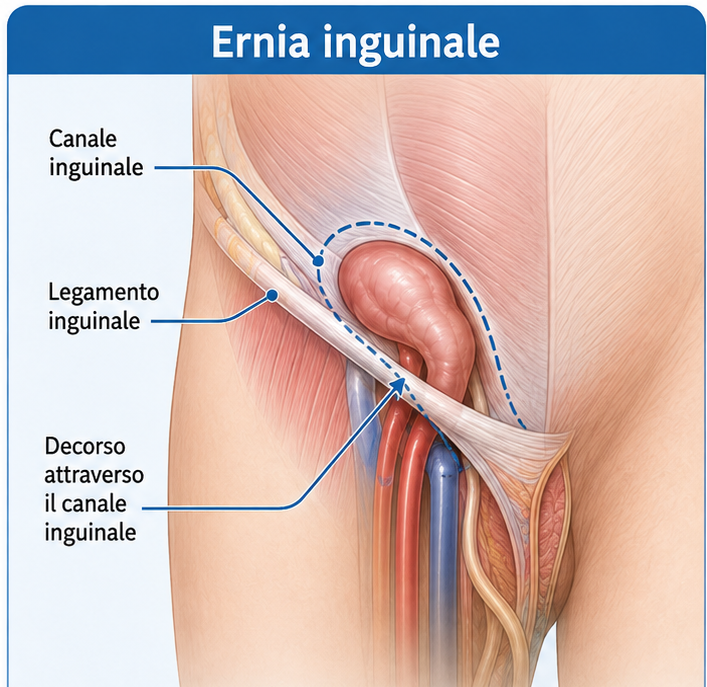
Inguinal hernia
- develops through the inguinal canal;
- is generally located higher up;
- is much more common;
- in men, may follow the course of the spermatic cord;
- often produces a more obvious bulge.
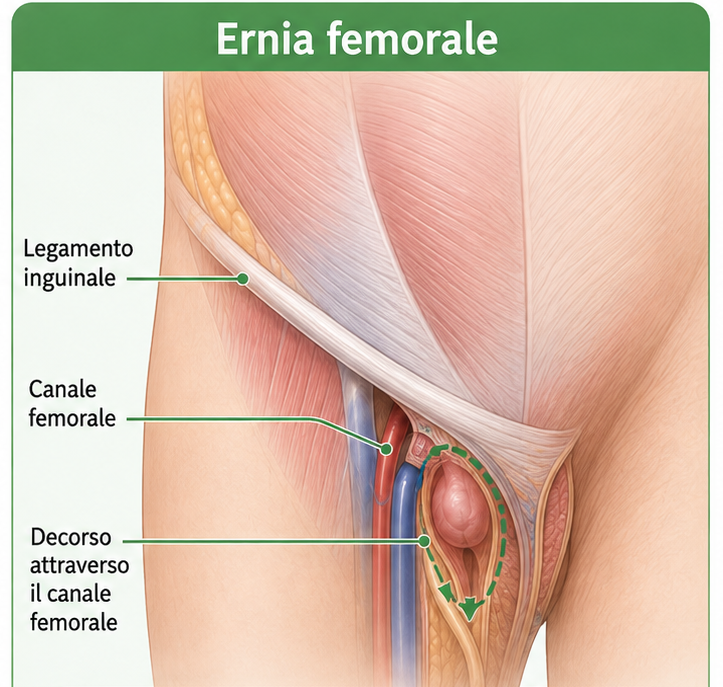
Femoral hernia
- passes through the femoral canal;
- appears below the inguinal ligament;
- can be very small;
- is particularly important in women;
- can be more difficult to recognise clinically;
- the narrow site of the defect makes timely diagnosis particularly important.
Why is femoral hernia particularly important in women?
Easily mistaken for an inguinal hernia
a small femoral swelling can easily be mistaken for an inguinal hernia or another cause of pain in the region.
Guidelines recommend considering the possibility of a femoral hernia in women with a suspected inguinal hernia and recommend laparo-endoscopic mesh repair specifically to reduce the risk of missing a femoral defect.
Why might diagnosis be delayed?
It may be:
This makes it particularly important to examine the entire inguinofemoral region, not just the site reported as painful.
Femoral hernia in female athletes

Symptoms that warrant assessment of the abdominal wall include:
Pain in female athletes: it is not always pubalgia
The differential diagnosis may include:
Persistent pain below the groin should therefore not automatically be labelled "pubalgia" before a wall defect has been excluded.
A female athlete with groin pain but no obvious bulge?
The absence of a large "lump" does not rule out a small femoral hernia. A dynamic examination and, where appropriate, ultrasound can clarify the cause of the pain.
What are the symptoms of a crural hernia?
Asymptomatic
Discovered incidentally during examination or imaging.
Symptomatic
It may cause:
- small bulge below the groin;
- pain in the upper thigh;
- a feeling of heaviness;
- pain when walking;
- discomfort when standing;
- pain when coughing or straining;
- pain during sport;
- tightness in the groin crease;
- tender swelling;
- a small bulge that decreases when lying down.
Reducible femoral hernia
The contents may return spontaneously when lying down or during a gentle reduction manoeuvre.
Irreducible femoral hernia
The contents remain lodged in the canal and do not go back in.
The key anatomical feature is the relatively narrow neck through which the hernia contents pass. This makes a femoral hernia clinically more concerning than many other small abdominal wall hernias and contributes to the greater attention paid to the risk of incarceration. This is why it is better not to delay surgery!
When does a femoral hernia become urgent?
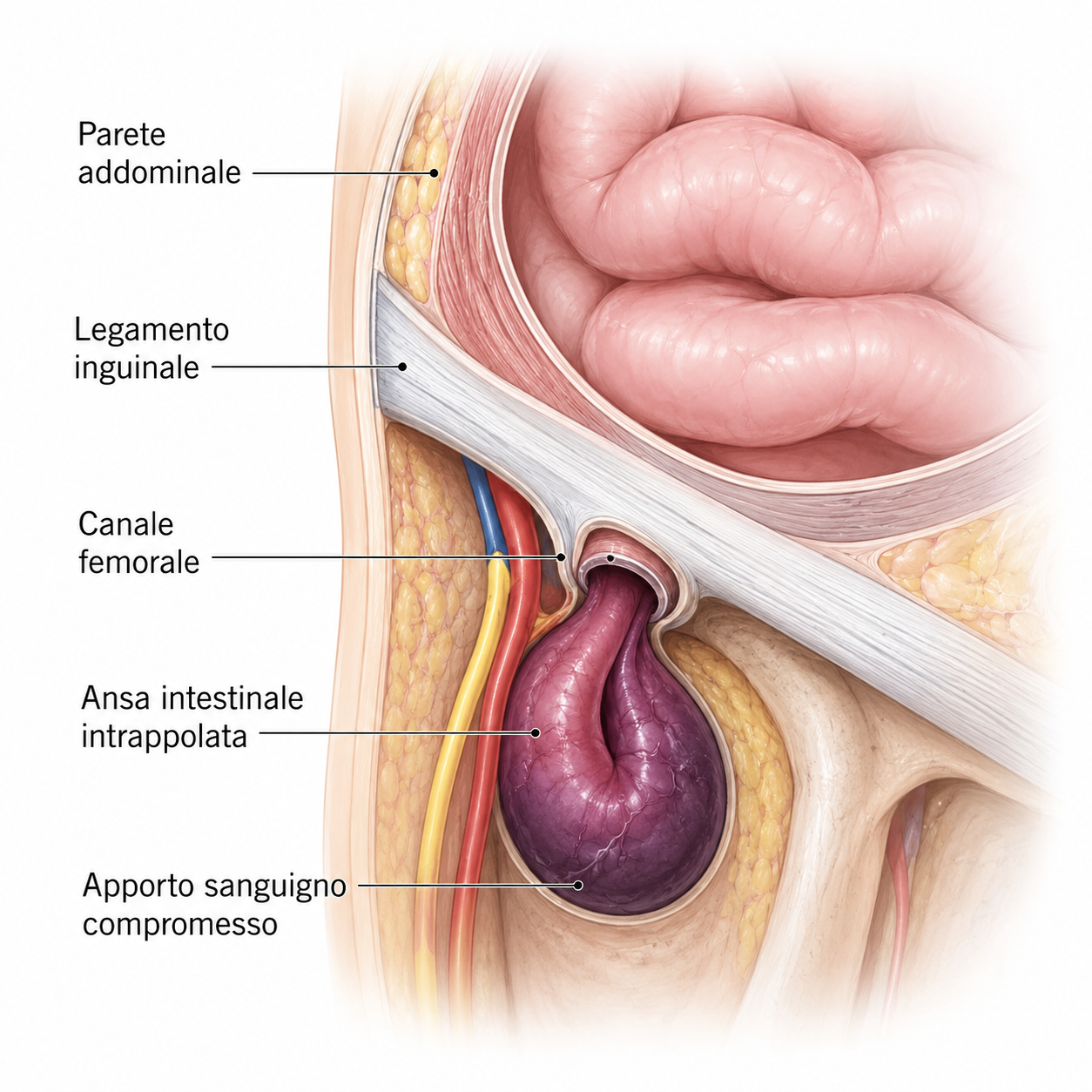
Prompt assessment is required in the presence of:
- sudden, severe pain;
- a hard swelling;
- a bulge that does not go back in;
- rapidly increasing pain;
- nausea;
- vomiting;
- abdominal pain;
- abdominal distension;
- altered bowel transit.
These symptoms may indicate incarceration or strangulation of the hernia contents.
A small, very painful bulge should not be underestimated simply because it is small.
How is a femoral hernia diagnosed?
Surgical consultation
Assessment should be performed:
Examination should cover both inguinofemoral regions, also checking for any associated inguinal hernia.
Dynamic ultrasound of the inguinofemoral region
It may be useful to:
- identify small defects;
- determine the contents;
- observe behaviour during the Valsalva manoeuvre;
- distinguish between inguinal and femoral hernias;
- assess a barely apparent swelling;
- compare both sides.
CT or magnetic resonance imaging
These may be used in cases that are:
- uncertain;
- recurrent;
- complex;
- with previous surgery;
- when other causes of pain need to be excluded;
- in female athletes with persistent pain but inconclusive clinical findings.
When should surgery be considered?
The threshold for concern with a femoral hernia differs from that for a simple asymptomatic inguinal hernia.
The recommendation is timely repair using minimally invasive techniques in women with groin hernias and suspected crural hernias
Planning nevertheless takes account of:
Can a femoral hernia heal on its own?
No.
A true wall defect does not close spontaneously. Support belts, medication or reduced activity may temporarily alter symptoms but do not eliminate the anatomical defect.
How is a crural hernia repaired?
Surgery must:
- 01precisely identify the femoral defect;
- 02reduce the contents;
- 03check the viability of the contents when necessary;
- 04adequately cover the femoral canal;
- 05identify any associated inguinal defects;
- 06reinforce the region with mesh when indicated;
- 07reduce the risk of recurrence.
Why is minimally invasive surgery particularly relevant in women?
A laparoscopic or robotic approach allows visualisation of the entire inguinofemoral region from the posterior aspect and simultaneous assessment of:
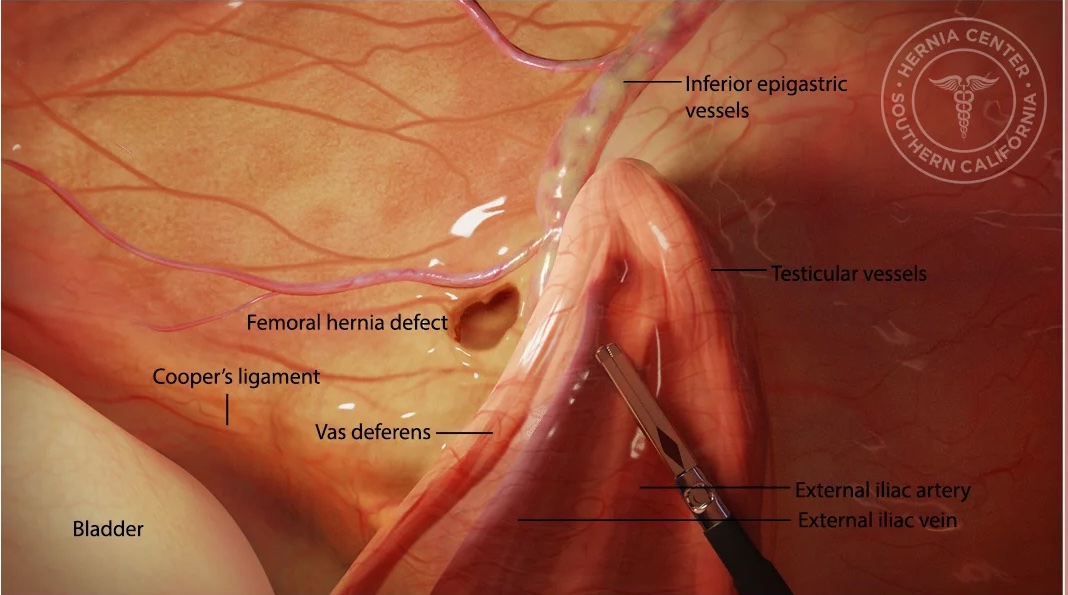
This is one of the reasons why guidelines recommend, when appropriate expertise is available, the laparo-endoscopic approach in women with groin hernias and femoral hernias
In women, treatment should not be limited to "closing a lump".
It is important to explore the myopectineal region properly so as not to overlook a femoral defect or an associated inguinal hernia.
Laparoscopic or robotic surgery
Laparoscopic surgery
Laparoscopic surgery provides a posterior view of the entire region and allows placement of a large mesh in the preperitoneal space.
It can allow the surgeon to:
- treat the femoral defect;
- identify any inguinal hernia;
- assess the opposite side;
- cover a wider area of potential weakness.
TAPP technique · TEP technique
Robotic surgery
The robotic approach applies the same anatomical principles as posterior repair, using three-dimensional vision and articulated instruments.
It may be used in selected cases for:
- preperitoneal dissection;
- treatment of associated defects;
- some recurrent or complex cases.
TAPP technique · TEP technique
If an associated inguinal hernia is also present, this will also be repaired and the mesh will cover all areas of weakness!
Returning to sport after surgery
In female athletes, the return to activity should be gradual and based on:
- 1Immediately
Daily activities
Mobilisation and light activities are generally resumed early.
- 2Approximately 20 days after surgery
Running and aerobic activity
Activity can be resumed gradually:
Walking → light aerobic activity → running → high-intensity activity.
- 3Approximately 30 days after surgery
Weight training and demanding sports
Squats, deadlifts, abdominal exercises, jumps and explosive movements should be reintroduced gradually after a follow-up assessment.
Frequently asked questions about crural or femoral hernia
Are a crural hernia and a femoral hernia the same thing?
+
Yes. These are two terms used to describe the same hernia, which passes through the femoral canal.
Are femoral hernias more common in women?
+
Femoral hernias account for a minority of groin hernias overall, but are particularly important in women; the guidelines therefore recommend specifically considering them in the differential diagnosis of groin swellings in women.
Can a woman who plays sport mistake it for pubalgia?
+
Yes. Pain in the groin and upper thigh may originate from muscles, tendons or joints, but can also be due to a small femoral defect; diagnosis requires clinical assessment and, where appropriate, dynamic imaging.
Can a femoral hernia heal on its own?
+
No. The anatomical defect does not close on its own.
Is it always visible as a bulge?
+
No. Some femoral hernias are small and deep and may present mainly with pain.
How is it distinguished from an inguinal hernia?
+
A femoral hernia passes through the femoral canal and lies lower than an inguinal hernia. Examination and dynamic ultrasound can help in uncertain cases.
Can it be repaired laparoscopically?
+
Yes. The guidelines recommend a laparo-endoscopic approach for femoral hernia repair when appropriate expertise is available.
Is mesh used?
+
For elective femoral hernia repair, the guidelines always recommend mesh repair.
Why should a painful swelling be assessed promptly?
+
Because the femoral canal is narrow and the hernia contents can become incarcerated; sudden pain, inability to reduce the hernia, nausea or vomiting require prompt medical assessment.