miSAR® – Minimally Invasive Stapled Abdominal Reconstruction is a minimally invasive abdominal wall surgery technique developed by Dr Gabriele Manetti to treat midline defects, particularly when hernias or incisional hernias are associated with rectus diastasis.
The aim is not simply to close the hernia defect, but to reconstruct the abdominal wall midline, restoring the anatomical relationship between the rectus muscles and reinforcing the reconstruction with a prosthesis placed in a protected anatomical plane.
Principle of the technique
Treat not only the hernia “hole”, but reconstruct the abdominal wall as a whole.
A new minimally invasive technique for the repair of diastasis recti: a pilot study.
Manetti G, Lolli MG, Belloni E, Nigri G.
Surgical Endoscopy. 2021.
DOI: 10.1007/s00464-021-08393-2
Minimally Invasive Stapled Abdominal Wall Repair: A New Surgical Technique.
Manetti G, Lolli MG, Belloni E, Nigri G.
Journal of Laparoendoscopic & Advanced Surgical Techniques. 2024.
DOI: 10.1089/lap.2024.0190
What is the miSAR® technique?
In miSAR®, the midline is reconstructed with a mechanical stapler, used to progressively reconstruct the wall along the linea alba.
Mechanical suturing provides a regular distribution of staples along the reconstruction line. The rectus muscles are progressively brought towards the midline and the reconstruction is then reinforced with a retromuscular prosthesis.
Reconstructing the midline
miSAR® is therefore based on a reconstructive concept: restoring midline continuity rather than limiting treatment to an individual hernia defect.
Mechanical suturing
Reconstruction is performed with a mechanical suturing instrument that applies 3 regular, equally spaced rows of staples along the fascia to distribute lateral tensile force evenly.
Experimental studies suggest that this suture is among the strongest.
Open the experimental study · PDFRetromuscular prosthesis
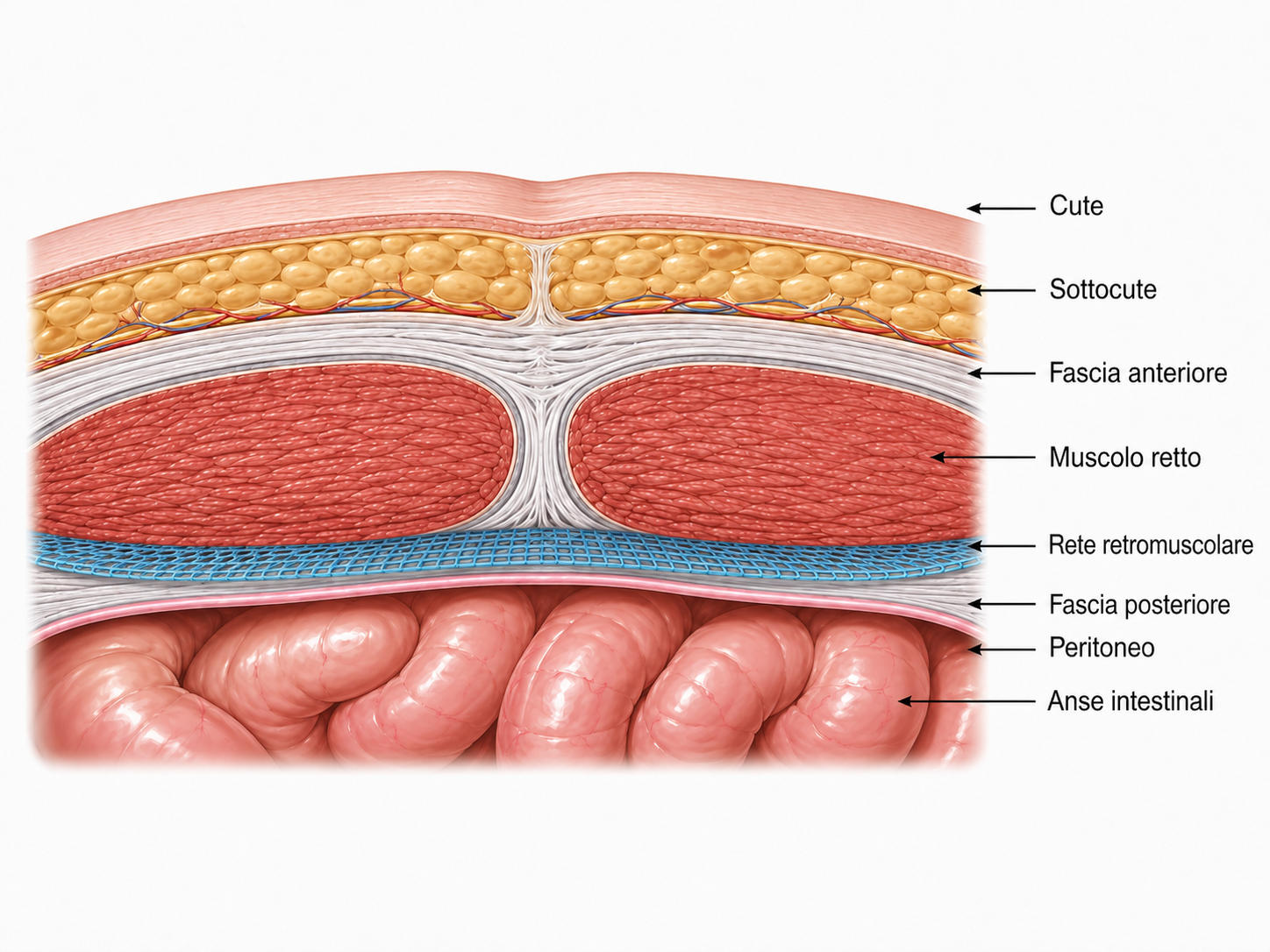
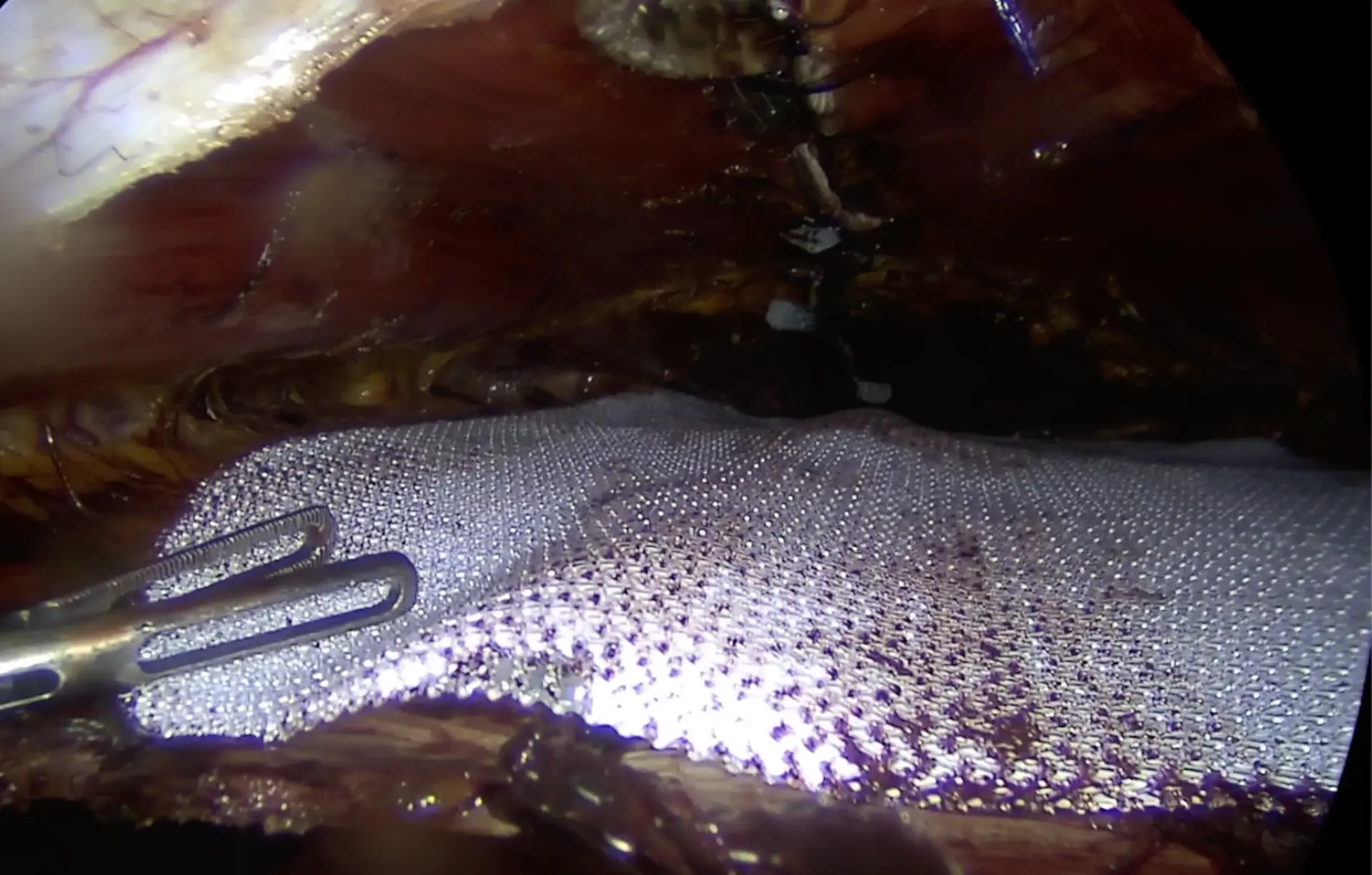
After reconstruction, mesh is placed in the retromuscular space, behind the rectus muscles.
The prosthesis:
- reinforces a broad area of the abdominal wall
- supports the midline reconstruction
- distributes forces across the wall
- remains separate from the abdominal viscera
- is not used merely as a “plug” for the defect
Which conditions can be treated?
The technique may be considered primarily for midline abdominal wall defects.
Appropriate patient selection is nevertheless essential, considering:
- Anatomical characteristics
- BMI
- Previous operations
- Defect size
- Presence of diastasis
- Defect location
How the operation is performed
01
Minimally invasive access
The operation is performed through small laparoscopic or robotic access points below the underwear line (scars not visible).
Access below the underwear line
02
Preparation of abdominal wall planes
The planes required for midline reconstruction and for the space intended for the prosthesis are developed.
03
Mechanical reconstruction
The midline is progressively reconstructed using mechanical suturing.
04
Rectus muscle approximation
Fascial reconstruction brings the rectus muscles closer together and restores central abdominal wall continuity. The anterior suture is further reinforced with a hand-sewn suture that also allows the umbilicus to be inverted.
Reinforcing hand-sewn suture and umbilical inversion
05
Mesh reinforcement
Mesh is placed in the retromuscular space to support and reinforce the reconstruction.
miSAR® and p-miSAR®: what is the difference?
p-miSAR® is an evolution of the miSAR® technique, retaining its reconstructive principle while performing the procedure through an extraperitoneal approach, avoiding entry into the peritoneal cavity whenever possible.
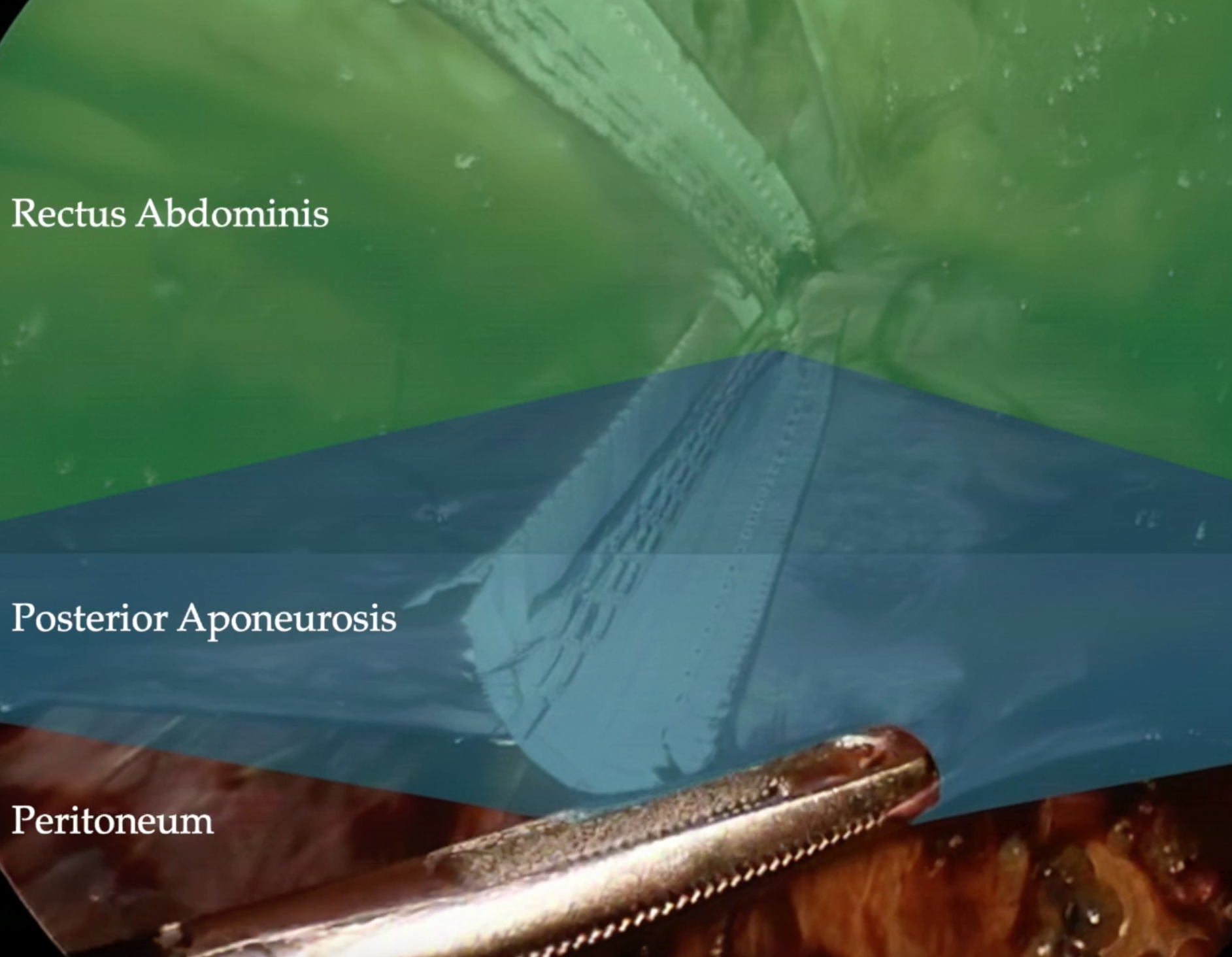
p-miSAR® also retains:
- midline reconstruction
- rectus muscle approximation
- mechanical suturing
- retromuscular mesh reinforcement
p-miSAR® allows extraperitoneal midline reconstruction to continue down to the pubic region, avoiding the intraperitoneal passage along the arcuate line required in the original technique.
miSAR® and p-miSAR® are not two “competing” operations.
The choice depends on anatomy, defect type, the presence of adhesions and the most appropriate reconstructive strategy.
Laparoscopy or robotic surgery?
miSAR® can be performed laparoscopically or, in selected cases, robotically.
Laparoscopic miSAR® or p-miSAR®
Laparoscopy allows the operation to be performed through small access points while retaining the principles of minimally invasive reconstruction.
Read moreRobotic miSAR® or p-miSAR®
The robotic platform may facilitate certain dissection and reconstruction steps in selected anatomies through three-dimensional vision and articulated instruments.
Robotic surgery is not necessarily a better technique overall: it is chosen when it can offer a concrete technical advantage in an individual case.
Read moreWhy reconstruct the entire midline?
When a hernia is associated with rectus diastasis, treating only the hernia defect addresses just part of the problem.
The entire midline must be assessed and its continuity, stability and function reconstructed.
Benefits of the miSAR® technique
Small access points
The operation uses a minimally invasive technique without a long midline incision.
Linea alba reconstruction
The technique treats the hernia and any associated diastasis at the same time.
Broad reinforcement
The prosthesis reinforces a large surface of the abdominal wall rather than only the hernia defect.
Mesh away from the bowel
The mesh is placed in a protected retromuscular plane.
Less abdominal wall trauma
The minimally invasive approach limits superficial tissue dissection compared with extensive open reconstructions.
Functional and aesthetic result
Bringing the rectus muscles closer together may improve wall stability and the midline contour.
miSAR® and plastic surgery
In patients with post-pregnancy diastasis or skin laxity, functional abdominal wall reconstruction may be combined, when indicated, with plastic surgery procedures during the same operation.
The same pathway may include assessment for:
- Abdominoplasty
- Mini-abdominoplasty
- Liposuction
- Liposculpture
- Scar revision
Assessment is performed together with the plastic surgeon to appropriately integrate functional reconstruction and any aesthetic goal.
Recovery after miSAR® and p-miSAR®
About 2 hoursOperation duration
Indicative operation duration: approximately 2 hours.
The same dayMobilisation and eating
On the same day: mobilisation with an abdominal binder and eating.
Around day 50Abdominal wall rehabilitation
After approximately 50 days: abdominal wall rehabilitation, following clinical assessment and according to the type of reconstruction performed.
Timing is personalised according to clinical assessment.
The rehabilitation pathway mainly includes:
- Core control
- Breathing
- Abdominal-pelvic coordination
- Management of intra-abdominal pressure
- Active and passive electrical stimulation
- Gradual return to sport and strenuous activity
Results and follow-up
The miSAR® technique has been the subject of successive scientific publications, from the first pilot experience to an expanded patient series and long-term follow-up.
The first published articles covered 219 patients; the results confirmed a limited operating time, the feasibility of the minimally invasive approach and a significant improvement in functional symptoms (stress urinary incontinence, low back pain, digestive problems and breathlessness), maintained at 6-month, 1-year and 2-year reviews.
Updated patient series · February 2026
By February 2026, 5-year follow-up data had been collected for 460 patients, identifying a recurrence risk of 1.2% and a postoperative complication risk (haematoma and seroma) below 2%.
These data describe the reported patient series and do not guarantee an individual patient’s result.
A new minimally invasive technique for the repair of diastasis recti: a pilot study.
Manetti G, Lolli MG, Belloni E, Nigri G.
Surgical Endoscopy. 2021.
DOI: 10.1007/s00464-021-08393-2
Minimally Invasive Stapled Abdominal Wall Repair: A New Surgical Technique.
Manetti G, Lolli MG, Belloni E, Nigri G.
Journal of Laparoendoscopic & Advanced Surgical Techniques. 2024.
DOI: 10.1089/lap.2024.0190
Frequently asked questions
What does miSAR® mean?
miSAR® stands for Minimally Invasive Stapled Abdominal Reconstruction, meaning minimally invasive abdominal reconstruction using mechanical suturing.
Does miSAR® also correct diastasis?
Yes. The technique was developed specifically to reconstruct the midline, bringing the rectus muscles closer together and treating any associated hernia defects at the same time.
Does miSAR® use mesh?
The reconstruction is generally reinforced with a prosthesis placed in the retromuscular space, keeping it separate from the abdominal viscera.
What is the difference between miSAR® and p-miSAR®?
p-miSAR® retains the principles of miSAR® but is performed through an extraperitoneal approach, avoiding entry into the peritoneal cavity whenever possible.
Can miSAR® be performed robotically?
Yes. It can be performed laparoscopically or robotically according to the anatomy and complexity of the case.
Is miSAR® suitable for all cases of diastasis?
No. The indication depends on defect size, anatomy, BMI, previous operations, the presence of hernias or incisional hernias and the patient’s goals.
How long is the hospital stay?
In selected patients, the stay can be short, often one night. The programme is nevertheless determined according to the operation and clinical condition.
When can rehabilitation begin?
Approximately around day 50, following clinical assessment and according to the type of reconstruction performed.