One of the first questions after deciding to have surgery is inevitably:
“How long will it take to get back to normal life?”
With minimally invasive techniques, daily life resumes almost immediately; however, effort must be managed carefully to respect the healing time of the muscle fascia.
Daily life resumes long before the fascia has fully healed.
After surgery and discharge
On the day of surgery
- You eat
- You get up
The day after surgery
- Blood tests
- Discharge
The abdominal binder: yes, it really is needed
After surgery an abdominal binder is generally recommended for about two months.
First month
Day and night.
Second month
Only during the day.
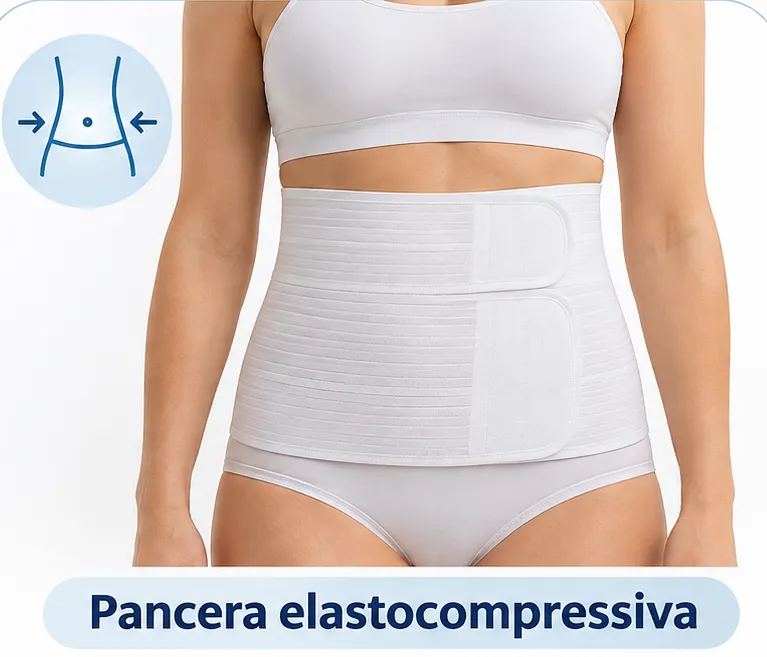
After the reconstruction, the lateral abdominal muscles naturally keep pulling outwards.
The binder helps reduce this pull on the midline during the early stages of healing, supporting the wall while the tissues progressively gain strength.
“But is it uncomfortable?”
In the first days some people find it stiff, bulky or too noticeable.
Then something curious often happens:
after a few weeks many patients no longer want to take it off.
The feeling of support becomes pleasant and, especially when moving or standing for many hours, the binder can give a greater sense of security.
Getting back to daily life
Immediate.
After minimally invasive procedures the ability to carry out daily activities returns very quickly.

From the first weeks you can
- walk
- drive
- move around several times a day
- breathe deeply
- gradually resume daily activities
- return to work
To avoid
- prolonged immobility
- lifting heavy loads
- sudden effort
- intense training
Remember
≈ 90days
Healing time of the muscle fascia
Relevant for techniques that suture the muscle fascia:
≈ 40days
First phase of mesh integration
Relevant for techniques that plicate the muscle fascia:
peTEPv-TAPP
The biological maturation of the mesh within the tissues continues afterwards.
How long does the pain last?
Thanks to minimally invasive approaches and advanced anaesthetic techniques, pain generally decreases progressively over the first days.
The most uncomfortable phase is often the initial one, especially during movements involving the trunk:
getting out of bedstanding up from sittingcoughingsneezinglaughingturning over in bed
during which it can often be controlled with paracetamol alone; afterwards it usually disappears.
ImportantIt is therefore important to remember not to strain, so as not to stress the suture line too early.
When can I go back to work?
It depends greatly on the type of activity.
Desk work
7–10days
It can be resumed relatively early, about 1 week to 10 days after surgery.
Physical work
It should be planned more cautiously. If the job involves:
- lifting weights
- handling loads
- repeated effort
- intense physical activity
the return must follow the biological timeline of the reconstruction.
Post-operative rehabilitation: generally after about 40 days
Once the first phase of healing is consolidated, an abdominopelvic rehabilitation programme can begin.
Rehabilitation starts about 40 days after surgery and is tailored to the type of procedure.
- Idiaphragmatic breathing
- IIcontrol of intra-abdominal pressure
- IIItransversus activation
- IVpelvic floor work
- Vtrunk stabilisation
- VIprogressive core recovery
Rehabilitation is not meant to passively “protect” the suture, but to teach the newly reconstructed wall to work correctly.
Returning to physical activity
Gradual.

After 2–3 months, once the wall has completed the main phase of healing, you can gradually return to exercises with weights.
The aim is not to restart everything at once, but to progressively increase intensity, weights and exercise complexity until a full return to sport.
Practical timeline
| Period | Main goal |
|---|---|
| First days | Walking and regaining independence |
| First weeks | Normal daily life while avoiding heavy effort |
| ≈ 40 days | Start of the rehabilitation programme |
| Afterwards | Gradual return to full sport depending on the procedure performed |
Timelines may vary depending on: technique usedextent of the procedureindividual characteristics
Frequently asked questions
Can I walk straight after surgery?
Yes. Early mobilisation is generally encouraged and is part of recovery.
How long should I wear the abdominal binder?
Usually about two months: day and night in the first month, mainly during the day in the second, unless advised otherwise.
When can I start physiotherapy?
After about 40 days, if recovery is progressing normally.
When can I go back to the gym?
It depends on the technique. After a fascial reconstruction heavy loads are generally avoided until the abdominal wall has fully healed, which takes between 2 and 3 months depending on the technique used.
Can I lead a normal life in the first weeks?
Yes. Daily life is resumed early; it is mainly heavy loads and intense effort that need to be temporarily limited.
After surgery, recovery should be quick but also smart
Getting moving early is important.
Going back to lifting heavy loads too early is not.
Progression is set according to the technique used and the biological healing times.