A surgical mesh is a thin, flexible sheet used to reinforce the abdominal wall after it has been reconstructed.
When diastasis surgery is discussed, one of the most frequent questions is:
“Is a mesh always necessary?”
The answer is: generally yes, because it further reinforces the reconstruction and reduces the risk of recurrence.
But the real question is: which mesh? Where is it placed?
The right choice concerns the type of prosthesis, its weight, elasticity and material and, above all, the anatomical plane in which it is placed.
When can a mesh be useful?
The prosthesis serves to reinforce the fascial reconstruction and distribute tension across the wall.
It is considered above all when there is:
- an associated umbilical hernia
- an associated epigastric hernia
- multiple midline defects
- weak muscle fascia
- an extensive reconstruction
- a wide diastasis
- recurrence after previous surgery
- high functional demand on the wall
- anatomical features that make prosthetic reinforcement useful
Meshes can be very different
Simply saying “a mesh will be used” actually says very little.
Prostheses differ in
The choice must therefore be personalised according to
Patient and lifestyle
age · occupation · sporting activity · sports with high core demand
Wall and medical history
tissue quality · previous surgery · chronic inflammatory diseases
Future plans
possible future pregnancies · any future need for other abdominal procedures
Non-absorbable meshes
Permanent
These are permanent synthetic prostheses, designed to provide lasting mechanical reinforcement.
They differ in: weight · porosity · elasticity
Partially absorbable meshes
Partial residue
They contain a permanent component and a component designed to degrade progressively.
The aim is to reduce the amount of residual material over time while still maintaining a reinforcing structure.
They can be an intermediate solution between permanent and fully absorbable prostheses.
Fully absorbable meshes
Absorbed
They are designed to progressively lose their structure while the wall develops its own scar tissue.
They are not equivalent to permanent meshes and are not appropriate for every situation.
The prosthesis must adapt to the wall and to the patient
Where is the mesh placed?
The main planes are:
Retromuscular
Gold standard- Outside the abdominal cavity
- No fixation needed
The mesh is placed behind the rectus muscles and in front of the posterior fascia.
It is a protected anatomical plane that keeps the prosthesis separate from the viscera while preserving the biomechanical functions of the wall.
No mesh fixation devices are needed.
Preperitoneal
- Outside the abdominal cavity
- No fixation needed
The prosthesis is placed between the posterior fascia and the peritoneum, and therefore outside the abdominal cavity.
This plane also maintains an anatomical barrier between the mesh and the bowel.
No mesh fixation devices are needed.
Intraperitoneal
- In contact with the viscera
- Requires fixation
The mesh is placed inside the abdominal cavity, in contact with the viscera.
The mesh must be fixed to keep it in position.
How is it fixed?
- Sutures
- Fixation devices such as tackers (small spirals that anchor the mesh to the wall)
- Glue (rarely)

Subcutaneous
- Above the rectus muscles
- Higher risk of seroma and infection
The mesh is placed in the subcutaneous tissue, above the rectus muscles (the typical plane after diastasis plication during abdominoplasty).
Higher risk of seroma and mesh infection.
Today the intraperitoneal plane tends to be avoided because of the risk of visceral adhesions over the years, and the subcutaneous plane because of the higher risk of seroma and mesh infection.
Whenever possible, a mesh should be separated from the bowel by a natural anatomical plane.
Where is the mesh placed in minimally invasive procedures?
It depends on the procedure.
In retromuscular and preperitoneal techniques the prosthesis is kept outside the abdominal cavity.
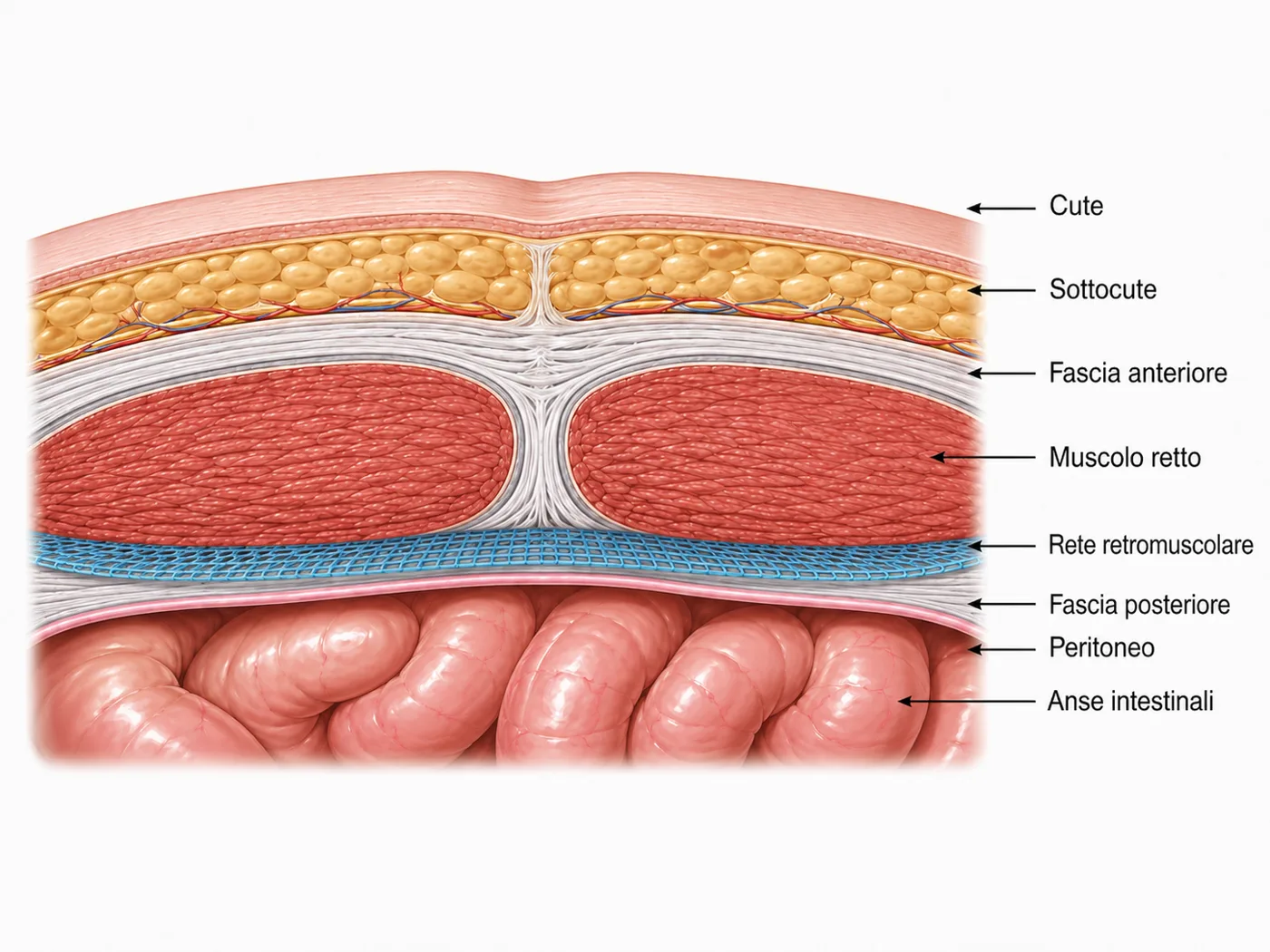
Retromuscular mesh
Behind the rectus muscles, in front of the posterior fascia
Outside the cavityTechniques
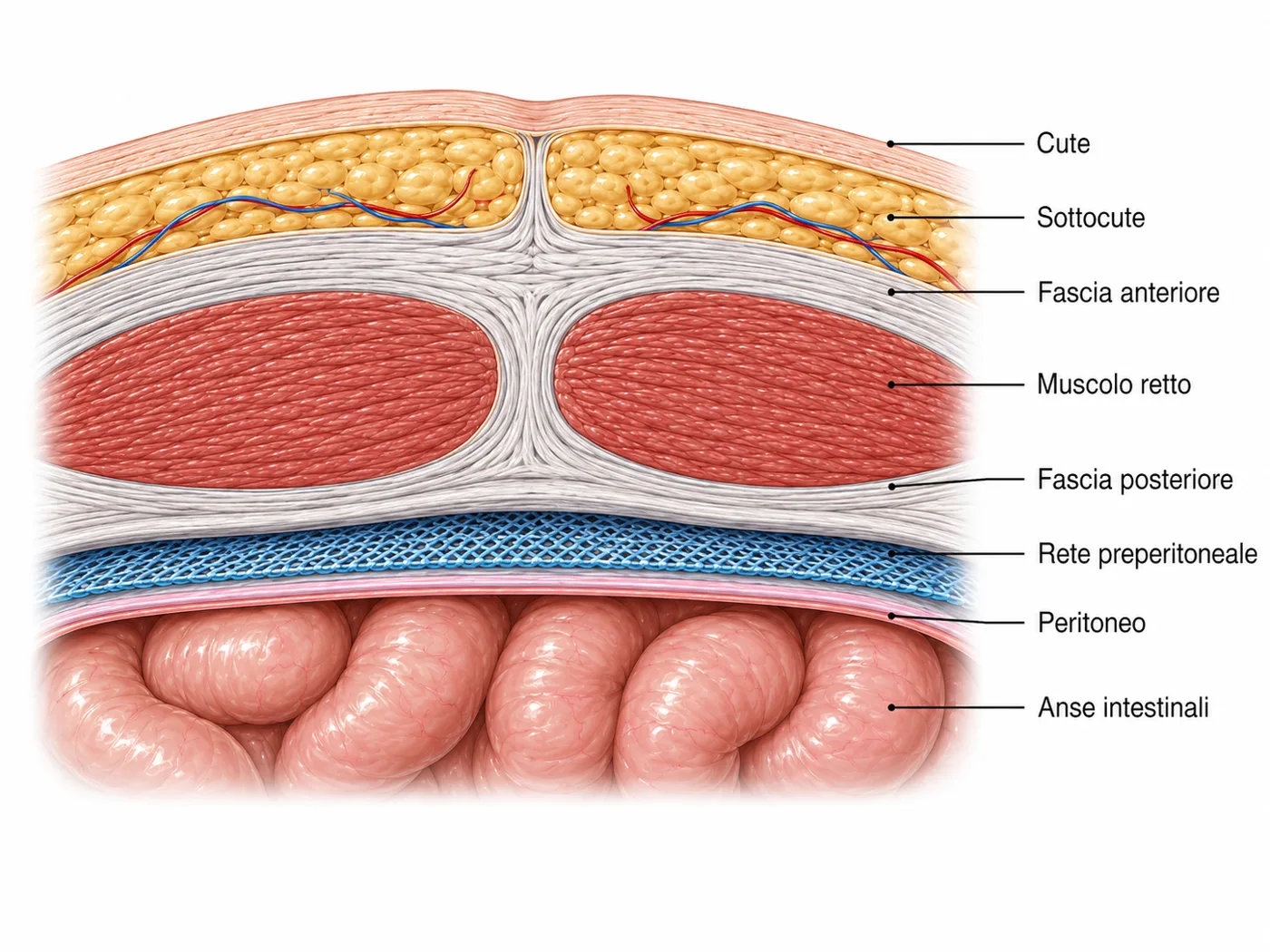
Preperitoneal mesh
Between the posterior fascia and the peritoneum
Outside the cavityTechniques
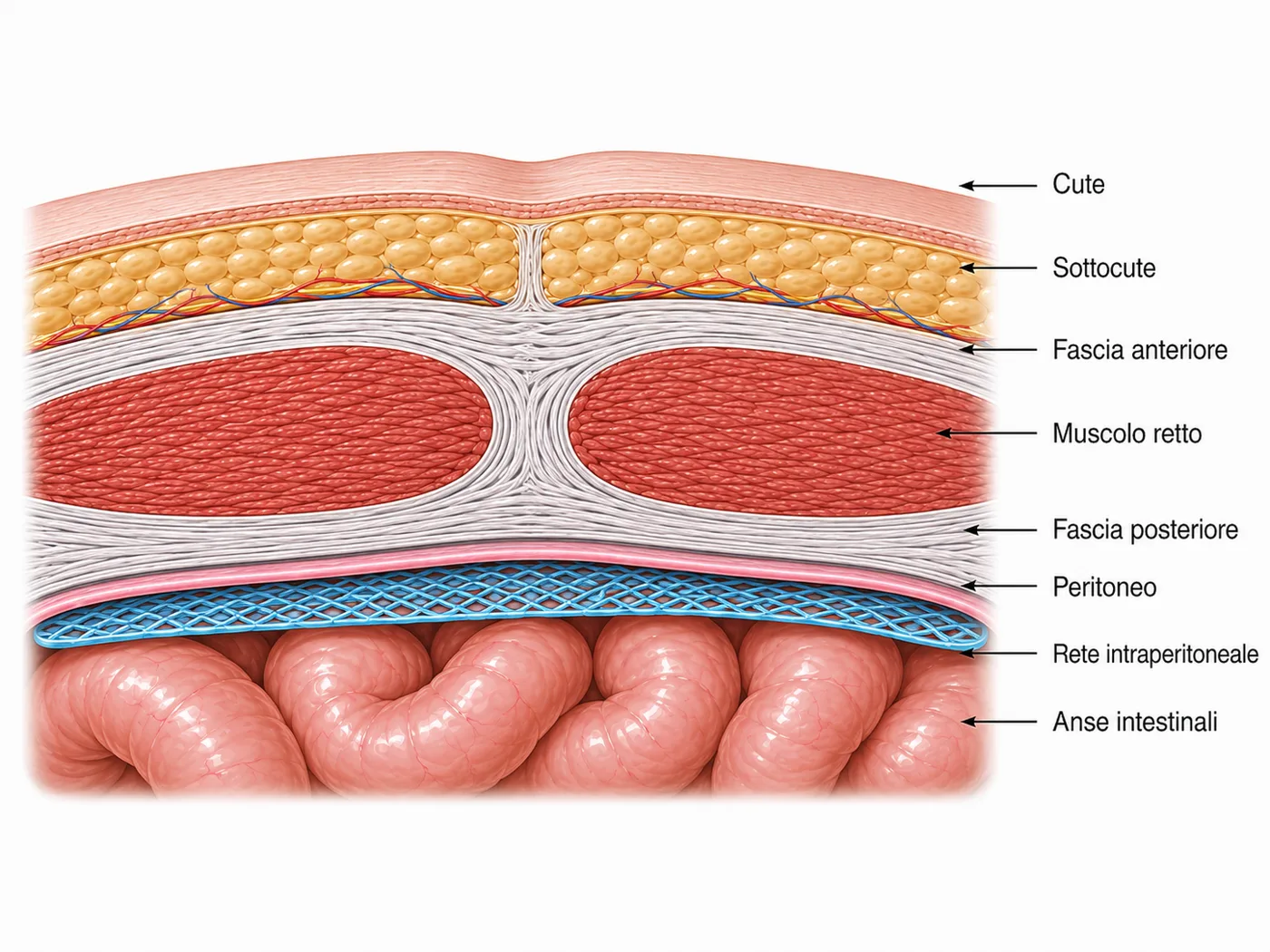
Intraperitoneal mesh
Inside the abdominal cavity, in contact with the viscera
Inside the cavityTechniques
The chosen technique also determines which plane can be used and which type of mesh is most appropriate.
Why avoid an intraperitoneal mesh whenever possible?
Prostheses designed for intraperitoneal use may have anti-adhesion barriers, but adhesions may still develop over time, including at the fixation points.
Contact with or proximity to the viscera may be associated with:
- Iadhesion formation
- IIgreater complexity of any future surgery
- IIIpossible problems with future pregnancies
- IVlong-term risk of complications related to the prosthesis and fixation devices
However, in some situations intraperitoneal prostheses are still essential.
Can you feel the mesh?
Generally not,when the type of mesh, its size and the plane of placement are chosen correctly.
One of the most common fears is permanently feeling a “foreign body”.
The sensation depends on several factors:
- 01amount of material
- 02elasticity
- 03stiffness
- 04pore size
- 05position of the mesh
- 06quality of the reconstruction
A mesh is a reinforcement, it must not replace the reconstruction
A mesh should not be used to “cover” a diastasis
without correctly reconstructing the wall.
To restore proper function, the main aim is to:
- 1reconstruct the midline
- 2restore anatomical tension
- 3treat any hernias
- 4use the prosthesis to reinforce the reconstruction
FAQ
Which is the best mesh?
There is no single best mesh. The choice depends on the reconstruction, the anatomical plane, tissue quality and the patient’s characteristics.
Is a lightweight or a heavyweight mesh better?
It depends on the function required. Lighter meshes tend to be more elastic, while heavier ones offer different mechanical properties. The choice must be individualised.
Can the mesh come into contact with the bowel?
In retromuscular and preperitoneal techniques the mesh is separated from the viscera. When possible, this makes it possible to avoid intraperitoneal placement.
Can a mesh cause problems in a future pregnancy?
A future pregnancy must be taken into account when planning surgery. The choice of plane and type of reconstruction can also be adapted to the patient’s future needs.
The question is not just “mesh or no mesh”
The right choice comes from studying the entire abdominal wall.
The type of defect, fascial quality, presence of hernias, sporting activity, possible future pregnancies and the surgical technique determine which prosthesis to use and, above all, where to place it.